
Busy Week

Last week I took a bye; this week I’ll show you why.

What Does It Mean to Be “Prohousing”?

Though our main mission is suing cities that block housing, we think the future is bright for cities that embrace it. One lesser-noticed component of housing-element law is the prohousing designation program, in which HCD has statutory authority to set the criteria by which cities are given bonus points for certain grant programs. As of December 15, 2022, the cities of Citrus Heights, Fontana, Oakland, Roseville, Sacramento, San Diego, and West Sacramento have been awarded this honor.

Anyone priced out today can tell you we need dramatic change to fix the housing crisis. HCD is considering changes to the prohousing designation program, and we think it’s a great opportunity to entice prohousing cities to lead the way. See our letter below.

 An “Alternative to Litigation” for the Builder’s Remedy

As we’ve written, dozens of Bay Area cities will be subject to the builder’s remedy starting in February. Last week, YIMBY Law worked with Californians for Homeownership and the California Housing Defense Fund (until recently CaRLA, of CaRLA v. San Mateo fame) to send demand letters out to these cities.

One way not to get sued is to agree that you’re subject to the law. Read our letter to Palo Alto—we sent the same letter everywhere—below.

Huntington Beach, You Can’t Exempt Yourself From state law!

I’m finishing up this post as the City Council of Huntington Beach is authorizing its city attorney to get Big Mad about the builder’s remedy. 13,000 new homes is too much, they say, and they want the State to “prove” that there’s a housing shortage. (Hey, Huntington Beach: I got priced out of Phoenix because of coastal California’s housing shenanigans. Now I live in a succession of sheds and spare bedrooms and have to move every month, and I’m Big Mad too. Go ahead, I’ll wait. I’ll still be here when you’re ready to be sued.)

Anyway, Huntington Beach can’t just declare itself immune from the law. I’m tired of thinking about this, so here’s the letter I wrote. Enjoy:


Bye Week

I read a lot of housing-element caselaw over the weekend, for a soon-to-be-not-so-secret project. On my mind: “There is a dearth of case law construing the inventory requirement” for housing elements (Fonseca v. City of Gilroy (2007) 148 Cal.App.4th 1174, 1197), and there are still problems with enforcing that requirement. So I’m taking a bye week to research whether and how our secret project can do anything about those problems.

Homes for the Holidays

We’re closing in on the end of the year, i.e., giving season. You know what I’m asking next.

I am the only attorney on staff at YIMBY Law, and I need help. Please donate so we can build the legal team we need to help end the housing crisis.

Thank you, and we’ll return with a more substantial post next week.

What Good Is the Law If It Makes People Homeless?

I’m posting from the hip after relocating from Los Angeles to Phoenix to Tucson to Berkeley over the last week. Got to visit old friends and their new kids, but little time to write a blog post. Hashtag, nomad life. Buckle in.

property rights are for everyone

Last week, I wrote that property law should be intuitive. Let’s explore this theme a little further.

Many of us share an intuition that people should be free to do what they want, short of harming others. Outside the specific context of housing, I’m not interested in what’s “harm” and what’s not. Whatever “harm” is, most people don’t—shouldn’t—care about things that don’t cause it.

In legalese, there’s a fancy Latin phrase for this concept: “sic utere tuo ut alienum non laedas.” (E.g., Vill. of Euclid v. Ambler Realty Co. (1926) 272 U.S. 365, 387; Green v. Gen. Petrol. Corp. (1928) 205 Cal. 328, 335.) I don’t know Latin, and I don’t know what this literally means. But Lexis can identify 1,154 appellate cases that quote it, and I’d wager it’s in most property-law textbooks. In lay terms, it means you can do what you want, as long as you don’t harm others.

Legally, home is a place where the law especially presumes that you can do what you want, and don’t harm others. We all live somewhere. This is why American law confers special legal protections on the home. At common law, “burglary” was specifically defined as breaking and entering someone else’s home. The Fourth Amendment specifically prohibits unreasonable searches and seizures of people’s “houses.” The Internal Revenue Code provides many tax benefits to homeowners. “In our tradition, the State is not omnipresent in the home.” (Lawrence v. Texas (2003) 539 U.S. 558, 562.) Shelter is a human need, and it’s humane to protect people in their homes.

Please, tell me again how hard you worked to buy your home in the ‘80s.

We don’t have to have tent cities. We just tolerate the policies that cause them. Though we still honor the home in some legal contexts, zoning law treats it as a special privilege rather than an equal right. This is new: the government hasn’t always suppressed the supply of housing. Plenty of civilizations, including America, have managed to house substantially all of their citizens. There’s no inherent reason home prices should outpace median income, as they have over the last generation.

Zoning Isn’t God’s Will

I talk to a lot of housing activists, and a common theme I notice is acquiescence in zoning law. It’s the playing field today, but we don’t have to accept it. Over and over, I hear questions about whether it’s legal for cities to impose x constraint on y-sized parcels in z zoning districts. (Often, the questions necessitate more prepositional phrases and abstractions than that.) The questions I want to hear are about why it’s legal to prohibit home construction at all.

No one would accept the premise of modern zoning as applied to any other basic human need. If the government made people choose between buying a single-family home barrel of apples or no home apples at all, there would be riots. This is exactly what minimum lot-size regulations do. And yet we tolerate a rigged housing “market” that does cause mass homelessness, and would cause mass starvation if applied to the grocery market.

A legal regime that impedes homefulness, without a clear health-and-safety reason, is illegitimate. Neighbors aren’t nuisances. I just spent a month living down the street from Skid Row; don’t talk to me about “the blessings of quiet seclusion” unless you own a secluded ranch. (Contra Vill. of Belle Terre v. Boraas (1974) 416 U.S. 1, 9.) We’ve inherited a regime that privileges legacy homeowners to ban other people’s homes. This regime is immoral, and it’s our duty to dismantle it.

Property Law Should Be Intuitive

Hope everyone had a restful long weekend. I went on a day trip to Sequoia National Park to look at giant 2,000-year-old trees:

This tree weighs approximately one hundred elephants.

These trees are survivors. They evolved in the flammable western Sierra; sequoia seeds can only sprout in charred soil. It works magnificently. Several sequoias alive today are older than most of the world’s religions.

Even so, climate change is causing too much fire even for these colossal conifers. In 2020, one fire killed more than a tenth of all the sequoias there were. We’re going to lose the rest of them if we don’t stop burning dead dinosaurs. 

If we’re going to stop burning dead dinosaurs, most of us will need to resume living in cities where people can walk. But first, a quick ask.

Giving Tuesday

I’ll make this short. It’s Giving Tuesday, and YIMBY Law needs your help to fight bad laws that strangle housing production, price vulnerable people out of their homes, and encourage unsustainable living patterns. I am, so far, the only lawyer on staff. I’m working for a teacher’s salary, in part so I face the same housing-cost burden that teachers face, and in part so YIMBY Law can hire more attorneys for me to work with. I can’t do this alone.

Please consider donating to YIMBY Law this holiday season. Thank you for your generosity. Now back to our regular programming.

On Property, the Common Law, and Zoning

Let’s be blunt: it’s stupid that walkable cities aren’t legal. It wasn’t so long ago that they were. America once had property law with walkable cities, long before it had property law without them.

Property law isn’t as old as the sequoias—nor as old as democracy in Mesoamerica—but it’s a survivor in its own right. American courts observe legal principles dating back not just to the Constitution—the “I’m Just a Bill” way that statutes are born—but, earlier still, to something known as the “common law.” The common law informs most of what we intuitively think of as “property law.”

No one made the common law. Medieval English judges developed it slowly, case by case, without statutes, over hundreds of years. It’s a bottom-up system that’s still evolving today.

It’s strange to me what gets written about as “property law” and what it doesn’t. I noticed this in a pair of New York Times articles last weekend. 

The first story, about a court case in rural Wyoming, shows how wealthy private ranch owners are fencing ordinary hunters out of public land. It’s explicitly about property law. The hunters have organized themselves, and they have a compelling court case. 

The second story, on how Americans are increasingly aging alone, has just as much to do with property law. There’s a very important fact that the article recognizes, albeit barely: zoning is the reason there are no smaller, more neighborly homes for older Americans to move into. A clear injustice, but unlike the Wyoming case, no one’s talking about a lawsuit.

I suspect the second article’s inattention to property law has something to do with zoning not being intuitive. The Wyoming case is interesting because it appeals to our intuition that public land should be accessible to the public. But a generation forced to age in isolation, because minimum lot-size regulations skew the housing market? How lonely, and how sad that we shrug at the stupid laws enforcing the loneliness.

So I am appealing to our intuition about time: property law is older—more of a survivor—than zoning. There are no “property rights” in zoning, a/k/a Herbert Hoover’s racist pet project from the 1920s. Zoning is ahistorical, and we can safely cancel it. Then we can ask more interesting questions, such as: how to reincorporate older and more sequoia-friendly Mesoamerican land-use principles into our common law? 

For now, we need to stop making apartments illegal.

We Think We’re Right About CEQA Exemptions

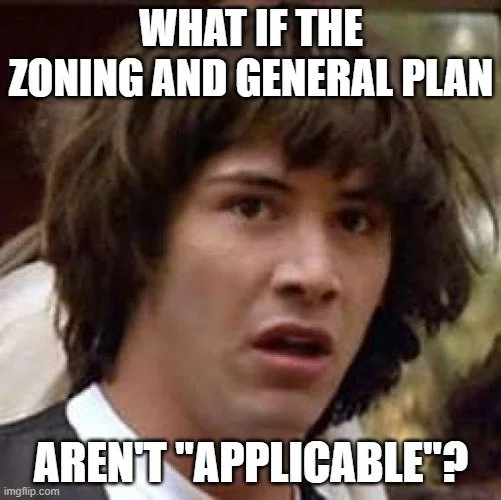
Two weeks ago, we argued that builder’s remedy projects may use certain CEQA exemptions, regardless of zoning-consistency requirements, because zoning isn’t “applicable” to builder’s-remedy projects. (E.g., CEQA Guidelines § 15332; cf. Harroman Co. v. Town of Tiburon (1991) 235 Cal.App.3d 388, 394–97.)

Great news! There’s another, better case to support this theory. (See Wollmer v. City of Berkeley (2011) 193 Cal.App.4th 1329, 1347–50 [holding that “zoning standards are not ‘applicable’” under CEQA when “waived” by operation of density bonus law].) Affordable-housing developers, ask your CEQA lawyer if Wollmer is right for your builder’s-remedy project.

Happy Thanksgiving.

Short post for a short week.

tHANK YOU, watchdogs

We depend on a network of volunteer watchdogs to make cities plan their fair share of housing. The housing shortage is unimaginably deep, and it’s going to take a mass movement to fix it.

You are that mass movement.

I listed dozens of names in an earlier draft, but it felt rushed and corny. I also don’t know that everyone wants their name published, not least—and this is both necessary and underappreciated—because a handful of you serve in planning departments, planning commissions, and city councils. (Congratulations, by the way!) Thank you, sincerely, to everyone who has flagged a housing issue for us this year, and please keep those reports coming.

Builder’s Remedy Projections for Santa Barbara County

November 17 was the last day for jurisdictions in Santa Barbara County to submit a draft housing element in time to avoid the builder’s remedy.

Affordable-housing developers, get ready: Carpinteria, Guadalupe, Lompoc, Santa Maria, Solvang, and unincorporated Santa Barbara County—home to expat and media royalty—will be subject to the builder’s remedy starting February 16.

***

Happy Thanksgiving, and safe travels to all who are traveling. We’ll post again next week.

Does It Matter that CEQA Refers to “Applicable” Planning and Zoning?

Last week, we toasted the impending suspension of 33 Bay Area zoning codes under the Housing Accountability Act’s “builder’s remedy,” and began exploring the California Environmental Quality Act. This week, we’ll tie the two together.

How Does the Builder’s Remedy Affect CEQA?

Mostly, it doesn’t. “Nothing” in the HAA “relieve[s]” a city from “complying with the California Environmental Quality Act.” (Cal. Gov. Code § 65589.5(e).)

This, along with CEQA’s notorious complexity, is why we advise consulting an experienced CEQA lawyer on any builder’s remedy project.

That said—

CEQA Exempts Some Kinds of Housing

The easiest way to approve a CEQA “project”is when the project is exempt. We recommend the State’s video on CEQA exemptions. At this point, most CEQA lawyers would switch into legalese and define the terms “discretionary,” “ministerial,” “statutory,” and “categorical”; they’re all legally meaningful, but we won’t dwell on them here.

CEQA and other laws exempt some kinds of housing projects from CEQA. Here are the big ones:

  • “Ministerial” approvals. For our purposes, this mainly means 10% (or 50%) affordable projects in cities that are behind pace in producing housing. (See Gov. Code § 65913.4.) This works through a different process, separate from the builder’s remedy.

  • Small projects, or “Class 3.” This is how single-family homeowners get around CEQA, but it can cover a sixplex too. (CEQA Guidelines § 15303.)

  • Infill development, or “Class 32.” (CEQA Guidelines § 15332.) “Infill” isn’t defined in the regulation, which covers “project site[s] of no more than five acres substantially surrounded by urban uses.”

  • Farmworker, low-income, urban infill near transit, and urbanized infill in unincorporated counties—if there’s “[c]ommunity-level environmental review” on file. (See CEQA §§ 21159.20–.28.)

  • “Transit priority projects” as part of a “sustainable communities strategy.” (See CEQA §§ 21155–21155.4.)

Here’s more State guidance. All of these exemptions are vastly more complicated than presented here, so don’t file a bar complaint against me for failing to tell you so.

CEQA Exemptions and the Builder’s Remedy

In a builder’s-remedy context, one key issue with all these exemptions—except for class 3—is the requirement for “consisten[cy] with the applicable general plan designation … as well as with [the] applicable zoning designation.” (E.g., CEQA Guidelines § 15332(a); accord CEQA § 21159.21(a); see also CEQA § 21155(a).) This is important because a builder’s remedy project, almost by definition, isn’t going to be consistent with the general plan and/or zoning designations. (See Cal. Gov. Code § 65589.5(d)(5).) Most CEQA lawyers and veteran housers I’ve talked to believe that a CEQA exemption’s requirement for general plan and zoning consistency would make the exemption inapplicable to a builder’s remedy project. So, that’s a problem.

As I see it, however, these consistency requirements raise an interesting question about the builder’s remedy:

CEQA Lawyers, What Am I Missing?

The builder’s remedy expressly states that a local government “shall not disapprove a housing development project” on the basis of “inconsisten[cy] with … the jurisdiction’s zoning ordinance and general plan land use designation.” (Ibid.) To me, this suggests an argument that the builder’s remedy renders the general plan and zoning inapplicable to the project. Therefore, if a CEQA exemption only requires consistency with any “applicable” general plan or zoning designation, then the exemption ought to be available under the builder’s remedy when the builder’s remedy preempts the general plan and zoning.

There isn’t much law on what counts as “applicable,” but I’ve found one case. In Harroman Co. v. Town of Tiburon (1991) 235 Cal.App.3d 388, a developer sued for approval of a 70-home project that was consistent with the general plan in effect at the time of the application, but inconsistent with a draft revision of the general plan under consideration at the same time. (Id. pp.390–92.) The HAA provision on which the developer relied, today codified in Government Code § 65589.5(j)(1), supported approval for projects compliant with “applicable” planning and zoning standards. 

The relevant issue in Harroman was which version of the general plan—the one in force, or the draft under consideration—was “applicable.” (Id. p.394.) The Harroman court ruled that the draft general plan was the “applicable” one, based on another planning statute that made it so. (See id. pp.394–97.) In other words, housing lost in that case—but the case yields a legal principle that the operation of other statutes should bear on whether a general plan or zoning designation is “applicable.”

Back to CEQA, perhaps Harroman could support an argument that the builder’s remedy makes the general plan and zoning inapplicable, such that a CEQA exemption, otherwise requiring general-plan and zoning consistency, would be available for a builder’s remedy project that met the exemption’s other requirements. Again, I’m new to CEQA, and I’ve yet to research the issue exhaustively. It’s true that the builder’s remedy doesn’t preempt CEQA, but that doesn’t necessarily mean it doesn’t preempt general plan and zoning designations when they’re relevant under CEQA. I’m curious to hear what CEQA veterans think. After all, isn’t it obvious that all these CEQA exemptions are supposed to support various kinds of affordable, infill, and/or transit-oriented housing?

If I’m wrong—and I admit that I could be—please email keith@yimbylaw.org and tell me how. If I don’t hear from anyone, then YIMBY Law’s work on the builder’s remedy might be a little easier than we currently think.