
There's No Such Thing as "Self-Certification"

By the end of the month, HCD will have issued findings on some two dozen cities’ housing elements. Administrative procedure is confusing, and housing elements confuse people. Confusing procedures invite shenanigans. We hear a lot of questions about “self-certification” especially, and the short answer is that it’s a legal way for cities to dare litigation. The long answer is the subject of today’s post.

So–before (guessing!) Goleta, Moraga, San Carlos, Walnut Creek, Colma, San Mateo, Clayton, Danville, Lafayette, and Los Altos Hills learn they’ve got more work to do—let’s look at the statutory roadmap to substantial compliance: what substantial compliance is, and the administrative procedures for achieving it.

“Substantial Compliance” Is a Question of Law

If you’ve read our Sausalito petition,you know that “[s]ubstantial compliance is question of law.” (Pet., ¶ 195.) There are no magic words in law, but the term “question of law” carries legal significance. It refers to the kind of question that only a court can decide. This matters because HCD is not a court. HCD is an administrative agency, and even though it has the duty to “determine whether [a] draft … substantially complies” with the housing-element law (Gov. Code § 65585, subd. d)), HCD’s “written findings” (ibid.) are not binding on courts.

For emphasis: only a court can ultimately decide whether a housing element “substantially complies” with state law. (Fonseca v. City of Gilroy (2007) 148 Cal.App.4th 1174, 1191.) HCD’s determinations are just that: determinations. The courts are free to disagree with HCD, and when they do, their judgments (mostly) control.

  • As with most legal questions, and too often in California, it’s complicated and it depends. There are bits and pieces of the housing-element law, such as the timelines for rezoning, that depend more on HCD’s compliance determinations than those of the courts. (See Gov. Code § 65583, subd. (c)(1)(A) [it’s complicated].) For builder’s-remedy purposes, though, the courts’ compliance findings matter more than HCD’s.

Thing is, most housing elements never get litigated. Few developers want to litigate, and there aren’t (yet) enough YIMBY lawyers to challenge all the bad housing elements. (If you’re a hotshot litigator who’s dissatisfied with modern land-use law, please consider joining us.) For the majority of housing elements, where no one seeks a court judgment, HCD’s compliance findings are simply the best available proxy for “substantial compliance.”

In court, “ ‘substantial compliance’ … means actual compliance in respect to … every reasonable objective of the [housing-element] statute.” (Fonseca, above, at p.1185; see also Camp v. Bd. of Supervisors (1981) 123 Cal.App.3d 334, 348 [a pamphlet doesn’t cut it].) Yes, the “actual” is italicized in the court opinions.

In other words, “substantial compliance” all depends on what the housing-element statute requires. The stronger requirements, like those for constraint removal and about nonvacant lower-income sites, put the burden of proof on the government. (E.g., Gov. Code §§ 65583, subd. (c)(3); 65583.2, subd. (g)(2); 65587, subd. (d).) Weak requirements, such as the requirement to “[a]ffirmatively further[] fair housing,” delegate to cities the task of deciding which actions have “meaning[].” (See Gov. Code § 8899.50, subds. (a)(1), (d).) That’s too bad about the weak requirements, but the strong requirements do debunk the myth that “substantial compliance” means “close enough” or “come on, they tried.” No! Every reasonable objective of Section 65583.2—the site-inventory statute—is a real requirement. (See Fonseca, at pp.1196–97.) And a court can (almost) always enforce those requirements, no matter HCD’s findings.

  • Don’t get us started on California’s statutes of limitations.

Don’t Confuse “Certification” with “Compliance”

Like we said, confusing procedures invite shenanigans. We’ve heard a lot of chatter about “self-certification,” i.e., the adoption of uncertified housing elements. As we’ve written elsewhere, certification isn’t at all equivalent to compliance.

A housing element is an element of a general plan. (Gov. Code § 65302, subd. (c).) There are general rules for adopting general-plan revisions; we won’t get into those here. What we’re talking about today are the special rules for revising a housing element. Those rules are in Section 65585 of the Government Code.

The key characteristic of the housing-element revision statute is that it’s an administrative procedure. Section 65585 mandates administrative review of every housing element. HCD is the reviewing agency, and every local government is required to either get certified by HCD or else explain why the local government believes HCD’s findings are wrong. We’re confident the statute requires at least that much.

We read Section 65585 to require at least four distinct actions on the road to compliance: local governments must draft, submit, certify, and adopt. To “draft” is to post for public comment. (Subd. (b)(1).) To “submit” is to seek HCD review. (Ibid.) To “certify”—a term that isn’t in the statute, just fairly implied—is to provide “written findings” that a draft “substantially complies” with the housing-element law. (See subds. (d), (f)(2).) And to “adopt” is to enact in any manner provided by law. (Subds. (b)(1), (e), (f)(2), (g); see id. §§ 65350 et seq.) These are necessary, but not sufficient, procedural conditions for compliance: substantial compliance is a question of law!
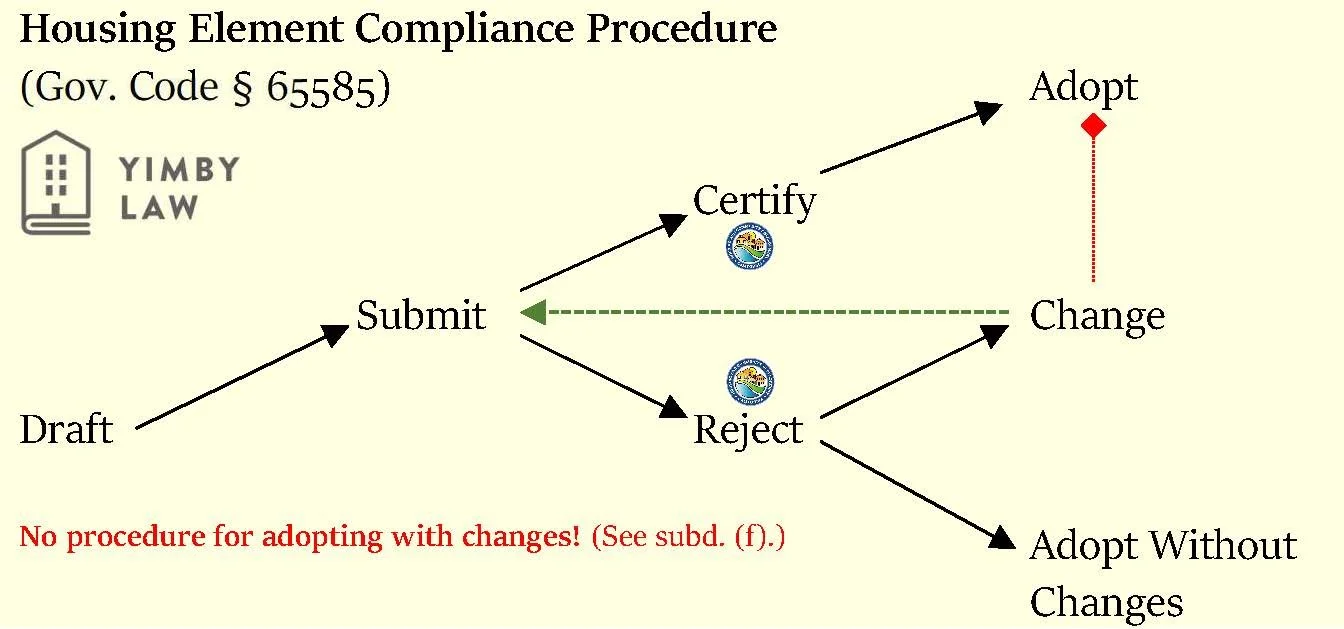
Most local governments get the first two procedures right. Things get dicey at and after the certification stage, where the intuitive ideal of “law” breaks down under a 40,000-word statute. We’ll put that problem aside for this paragraph. Obviously, HCD can certify a housing element. This creates a “rebuttable presumption” that the housing element is compliant. (Gov. Code § 65589.3.) Surprisingly to some, local governments can also adopt their housing elements “despite” HCD findings of noncompliance. (Id. § 65585, subd. (f)(2).) There’s just no presumption of validity without HCD certification. (Id. § 65589.3.)

The procedures for adopting an uncertified housing element are sadly too squishy. The governing provision is subdivision (f), and there’s a good argument that a local government, with HCD’s rejection in hand, may only take “one of the following actions”: either “[c]hange the draft … to substantially comply,” or “[a]dopt the draft … without changes.” (Gov. Code § 65585, subd. (f).) In practice, too many local governments to count have adopted their uncertified housing elements with changes. And we simply can’t sue them all.

We think the natural reading of Section 65585 provides for uncertified local governments to “change” their rejected housing elements by resubmitting for HCD certification before adopting. (Gov. Code  § 65585, subd. (f)(1).) The statute clearly authorizes that approach. And we respect that it is procedurally (though not substantially) compliant to adopt a rejected housing element “without changes.” (Id., subd. (f)(2).) But we cannot see how a city or county could argue that the Legislature intended them to make hasty changes in a dash to “self-certify” against the builder’s remedy. The closest viable approach to this argument can only depend on the statute being a word salad.

With all that being said, housing-element adoption shenanigans don’t yet appear to have been addressed by any appellate court. This can’t be lost on the cities that fear by-right affordable housing. As a strategic matter, we only have the resources to sue cities that flunk a clear procedure or adopt an especially bad housing element. So until the law clears up, we need you to demand your city certify with HCD before adopting its housing element.

We’ll cover public comment, and the metastasizing problem of post-adoption staff revisions, in our next post.

What Good Is the Law If It Makes People Homeless?

I’m posting from the hip after relocating from Los Angeles to Phoenix to Tucson to Berkeley over the last week. Got to visit old friends and their new kids, but little time to write a blog post. Hashtag, nomad life. Buckle in.

property rights are for everyone

Last week, I wrote that property law should be intuitive. Let’s explore this theme a little further.

Many of us share an intuition that people should be free to do what they want, short of harming others. Outside the specific context of housing, I’m not interested in what’s “harm” and what’s not. Whatever “harm” is, most people don’t—shouldn’t—care about things that don’t cause it.

In legalese, there’s a fancy Latin phrase for this concept: “sic utere tuo ut alienum non laedas.” (E.g., Vill. of Euclid v. Ambler Realty Co. (1926) 272 U.S. 365, 387; Green v. Gen. Petrol. Corp. (1928) 205 Cal. 328, 335.) I don’t know Latin, and I don’t know what this literally means. But Lexis can identify 1,154 appellate cases that quote it, and I’d wager it’s in most property-law textbooks. In lay terms, it means you can do what you want, as long as you don’t harm others.

Legally, home is a place where the law especially presumes that you can do what you want, and don’t harm others. We all live somewhere. This is why American law confers special legal protections on the home. At common law, “burglary” was specifically defined as breaking and entering someone else’s home. The Fourth Amendment specifically prohibits unreasonable searches and seizures of people’s “houses.” The Internal Revenue Code provides many tax benefits to homeowners. “In our tradition, the State is not omnipresent in the home.” (Lawrence v. Texas (2003) 539 U.S. 558, 562.) Shelter is a human need, and it’s humane to protect people in their homes.

Please, tell me again how hard you worked to buy your home in the ‘80s.

We don’t have to have tent cities. We just tolerate the policies that cause them. Though we still honor the home in some legal contexts, zoning law treats it as a special privilege rather than an equal right. This is new: the government hasn’t always suppressed the supply of housing. Plenty of civilizations, including America, have managed to house substantially all of their citizens. There’s no inherent reason home prices should outpace median income, as they have over the last generation.

Zoning Isn’t God’s Will

I talk to a lot of housing activists, and a common theme I notice is acquiescence in zoning law. It’s the playing field today, but we don’t have to accept it. Over and over, I hear questions about whether it’s legal for cities to impose x constraint on y-sized parcels in z zoning districts. (Often, the questions necessitate more prepositional phrases and abstractions than that.) The questions I want to hear are about why it’s legal to prohibit home construction at all.

No one would accept the premise of modern zoning as applied to any other basic human need. If the government made people choose between buying a single-family home barrel of apples or no home apples at all, there would be riots. This is exactly what minimum lot-size regulations do. And yet we tolerate a rigged housing “market” that does cause mass homelessness, and would cause mass starvation if applied to the grocery market.

A legal regime that impedes homefulness, without a clear health-and-safety reason, is illegitimate. Neighbors aren’t nuisances. I just spent a month living down the street from Skid Row; don’t talk to me about “the blessings of quiet seclusion” unless you own a secluded ranch. (Contra Vill. of Belle Terre v. Boraas (1974) 416 U.S. 1, 9.) We’ve inherited a regime that privileges legacy homeowners to ban other people’s homes. This regime is immoral, and it’s our duty to dismantle it.

Does It Matter that CEQA Refers to “Applicable” Planning and Zoning?

Last week, we toasted the impending suspension of 33 Bay Area zoning codes under the Housing Accountability Act’s “builder’s remedy,” and began exploring the California Environmental Quality Act. This week, we’ll tie the two together.

How Does the Builder’s Remedy Affect CEQA?

Mostly, it doesn’t. “Nothing” in the HAA “relieve[s]” a city from “complying with the California Environmental Quality Act.” (Cal. Gov. Code § 65589.5(e).)

This, along with CEQA’s notorious complexity, is why we advise consulting an experienced CEQA lawyer on any builder’s remedy project.

That said—

CEQA Exempts Some Kinds of Housing

The easiest way to approve a CEQA “project”is when the project is exempt. We recommend the State’s video on CEQA exemptions. At this point, most CEQA lawyers would switch into legalese and define the terms “discretionary,” “ministerial,” “statutory,” and “categorical”; they’re all legally meaningful, but we won’t dwell on them here.

CEQA and other laws exempt some kinds of housing projects from CEQA. Here are the big ones:

  • “Ministerial” approvals. For our purposes, this mainly means 10% (or 50%) affordable projects in cities that are behind pace in producing housing. (See Gov. Code § 65913.4.) This works through a different process, separate from the builder’s remedy.

  • Small projects, or “Class 3.” This is how single-family homeowners get around CEQA, but it can cover a sixplex too. (CEQA Guidelines § 15303.)

  • Infill development, or “Class 32.” (CEQA Guidelines § 15332.) “Infill” isn’t defined in the regulation, which covers “project site[s] of no more than five acres substantially surrounded by urban uses.”

  • Farmworker, low-income, urban infill near transit, and urbanized infill in unincorporated counties—if there’s “[c]ommunity-level environmental review” on file. (See CEQA §§ 21159.20–.28.)

  • “Transit priority projects” as part of a “sustainable communities strategy.” (See CEQA §§ 21155–21155.4.)

Here’s more State guidance. All of these exemptions are vastly more complicated than presented here, so don’t file a bar complaint against me for failing to tell you so.

CEQA Exemptions and the Builder’s Remedy

In a builder’s-remedy context, one key issue with all these exemptions—except for class 3—is the requirement for “consisten[cy] with the applicable general plan designation … as well as with [the] applicable zoning designation.” (E.g., CEQA Guidelines § 15332(a); accord CEQA § 21159.21(a); see also CEQA § 21155(a).) This is important because a builder’s remedy project, almost by definition, isn’t going to be consistent with the general plan and/or zoning designations. (See Cal. Gov. Code § 65589.5(d)(5).) Most CEQA lawyers and veteran housers I’ve talked to believe that a CEQA exemption’s requirement for general plan and zoning consistency would make the exemption inapplicable to a builder’s remedy project. So, that’s a problem.

As I see it, however, these consistency requirements raise an interesting question about the builder’s remedy:

CEQA Lawyers, What Am I Missing?

The builder’s remedy expressly states that a local government “shall not disapprove a housing development project” on the basis of “inconsisten[cy] with … the jurisdiction’s zoning ordinance and general plan land use designation.” (Ibid.) To me, this suggests an argument that the builder’s remedy renders the general plan and zoning inapplicable to the project. Therefore, if a CEQA exemption only requires consistency with any “applicable” general plan or zoning designation, then the exemption ought to be available under the builder’s remedy when the builder’s remedy preempts the general plan and zoning.

There isn’t much law on what counts as “applicable,” but I’ve found one case. In Harroman Co. v. Town of Tiburon (1991) 235 Cal.App.3d 388, a developer sued for approval of a 70-home project that was consistent with the general plan in effect at the time of the application, but inconsistent with a draft revision of the general plan under consideration at the same time. (Id. pp.390–92.) The HAA provision on which the developer relied, today codified in Government Code § 65589.5(j)(1), supported approval for projects compliant with “applicable” planning and zoning standards. 

The relevant issue in Harroman was which version of the general plan—the one in force, or the draft under consideration—was “applicable.” (Id. p.394.) The Harroman court ruled that the draft general plan was the “applicable” one, based on another planning statute that made it so. (See id. pp.394–97.) In other words, housing lost in that case—but the case yields a legal principle that the operation of other statutes should bear on whether a general plan or zoning designation is “applicable.”

Back to CEQA, perhaps Harroman could support an argument that the builder’s remedy makes the general plan and zoning inapplicable, such that a CEQA exemption, otherwise requiring general-plan and zoning consistency, would be available for a builder’s remedy project that met the exemption’s other requirements. Again, I’m new to CEQA, and I’ve yet to research the issue exhaustively. It’s true that the builder’s remedy doesn’t preempt CEQA, but that doesn’t necessarily mean it doesn’t preempt general plan and zoning designations when they’re relevant under CEQA. I’m curious to hear what CEQA veterans think. After all, isn’t it obvious that all these CEQA exemptions are supposed to support various kinds of affordable, infill, and/or transit-oriented housing?

If I’m wrong—and I admit that I could be—please email keith@yimbylaw.org and tell me how. If I don’t hear from anyone, then YIMBY Law’s work on the builder’s remedy might be a little easier than we currently think.

Why the California "Builder's Remedy" Means What It Says

We’re a week closer to the housequake. This week: why we work with untested law, a plain reading of the builder’s remedy, and a special invitation.

“No One … Underst[ands] the Full Scope” of Housing Reform

Over the weekend, Ezra Klein wrote in depth about Los Angeles’s failure (so far) to build “affordable” housing at less than $600,000 per unit. It’s a great article. In 2016, Los Angeles voters approved $1.2 billion to construct 10,000 new homes. Six years later, just a third of those homes have been built, at a cost north of $2 billion (the city doesn’t fund all of it), and the slow progress is being debated in the Los Angeles mayor’s race. Klein’s article raises excellent questions about why affordable housing is so hard.

The most important part of the affordable-housing equation is time. No one can build a home overnight. Even if there were infinite land and no laws to delay housing production, it would still take time to line up the people and materials builders need to make a new home. Then, if there’s no supply crunch, homes become cheaper with age, as mortgages get paid off and original owners vacate for newer buildings. Jane Jacobs wrote a chapter on this phenomenon in her magnum opus The Death and Life of Great American Cities (see ch. 10). And that’s to say nothing of the fitful way funds are Frankensteined together, which Klein covers in his article.

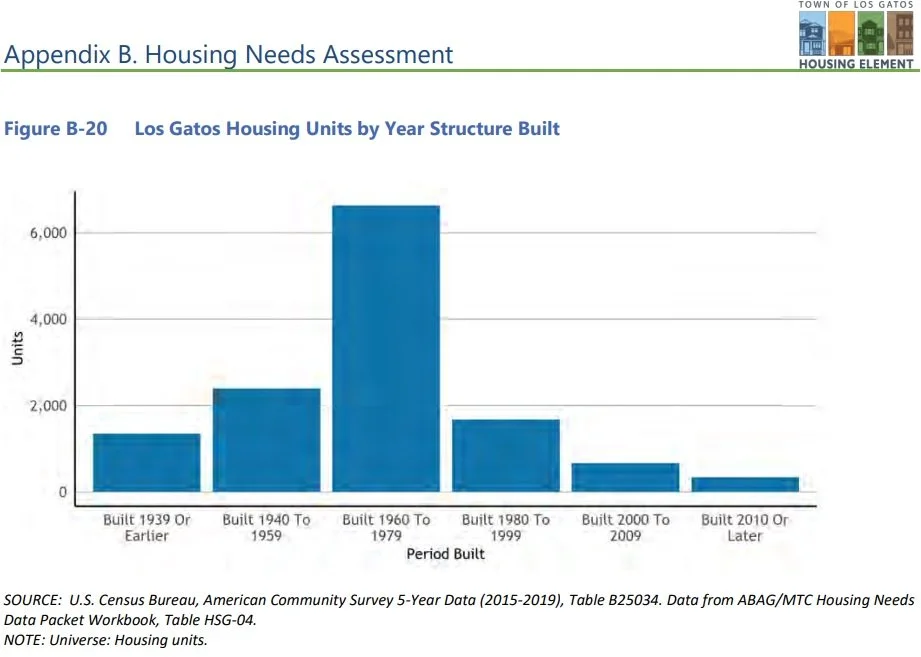
Unfortunately, we are in a supply crunch: see how home construction crashed after the Great Recession, for one thing. That would be bad enough, but the roots of the supply crunch are deeper than that. California cities’ housing elements report a home-production boom shortly after the baby boom, and close to nothing since the advent of downzoning in the 1970s.

A middle finger to modern generations, from Los Gatos’s draft housing element (p.B-23)

Today’s supply crunch is the product of a half-century of nimby policy. That’s the main problem: we can’t make up for fifty lost years in the next five. Still, housing is a basic human need, and we have to make up for as much lost time as we can. That’s the point of all the prohousing reforms that the YIMBY movement has recently gotten passed.

Klein nods at these reforms toward the end of his article, and this quote jumps out: “no one … underst[ands] the full scope” of California’s new housing laws. They’re all a work in progress, and much remains to be litigated. But it’s clear the new laws are YIMBY in spirit. That will matter when courts interpret their letter.

The Builder’s Remedy Means What It Says

One of the reforms we’re promoting at YIMBY Law is the builder’s remedy. You’ve likely read about it, and we’re getting lots of questions about how it works.

Let’s start this week with the first rule of statutory construction: read the statute. The builder’s remedy was enacted in 1990 as an intentional addition to the Housing Accountability Act (“HAA”). The remedy is available to certain affordable* developments, unless a city proves one of five defenses:

A local agency shall not disapprove a[n affordable] housing development project … including through the use of design review standards, unless … :

(1) The jurisdiction has adopted a [compliant] housing element … and the jurisdiction has met or exceeded its [RHNA]** for the planning period ….

(2) The housing development project … would have a specific, adverse impact …‌. Inconsistency with the zoning ordinance or general plan land use designation[ is not a “specific, adverse impact”].

(3) … [S]tate or federal law [requires disapproval] ….

(4) The … land [is] zoned for agriculture or resource preservation*** … or [needs] water or wastewater facilities ….

(5) The … zoning ordinance and general plan [required disapproval] on the date the application was deemed complete, and the jurisdiction has adopted a [compliant] housing element ….****

(Gov. Code § 65589.5(d) [italics added].) Again, the default rule is that the builder’s remedy applies, unless the city establishes one of these five defenses.

  • “Affordable,” for builder’s-remedy purposes, refers to the way California law classifies households as “lower” (well below median) or “moderate” (near median) income. The builder’s remedy applies to projects where either 20 percent of the homes are affordable to lower-income households, or else all of the homes are affordable to moderate-income households.xt goes here

  • “RHNA” is short for “regional housing need allocation,” determined with reference to “income category.” (Cal. Gov. Code § 65589.5(d)(1).) Mixed-income projects can overcome this builder’s-remedy defense if the city is behind its RHNA in any of the project’s income categories. (Ibid. [enabling HCD to “calculate[]” RHNA progress]; see also id. § 65400(a)(2)(B) [requiring cities to report progress annually].)

  • This defense also requires that the land is “surrounded on at least two sides by land being used for agriculture or resource preservation.” (Id. § 65589.5(d)(4).)

  • Cities may not invoke this defense on sites in their housing-element site inventory. Cities with bad site inventories may not invoke this defense on any residential site. (Id., subd. (d)(5)(A)–(C).)

The main builder’s-remedy defense is when local zoning prohibits the project and the city has a compliant housing element. (Id., subd. (d)(5).) Zoning often prohibits projects. Housing-element law wasn’t well-enforced in the past, but that’s changing. Over 90% of cities in Southern California missed last year’s housing-element deadline, many missed it again after the Legislature extended that deadline, and we’re projecting more than half of Bay Area cities will miss their upcoming deadline on January 31. That will take away the main defense to the builder’s remedy, meaning lots of cities without zoning.

The builder’s remedy means what it says. HCD confirmed this in an October 5 letter supporting a 2,000-home builder’s-remedy project in Santa Monica. We anticipate cities will argue that another HAA provision creates a loophole for “objective … development standards,” but the second rule of statutory construction is: keep reading the statute. The “fundamental task … is to determine the Legislature’s intent so as to effectuate the law’s purpose.” (San Jose Unif. Sch. Dist. v. Santa Clara Cnty. Office of Educ. (2017) 7 Cal.App.5th 967, 975 [quoting People v. Cornett (2012) 53 Cal.4th 1261, 1265].) And the HAA goes on to say that its “development standards” clause “shall not be construed in a manner that would lessen the restrictions imposed on a local agency, or lessen the protections afforded to a housing development project” by the builder’s remedy. (See Cal. Gov. Code § 65589.5, subds. (f)(1), (o)(5).) In other words, the “development standards” clause isn’t a defense to the builder’s remedy: it’s only for cities that have a builder’s-remedy defense in the first place.

A Special Invitation

Join YIMBY Law on Thursday at 1pm Pacific for a conversation with Dave Rand, the lawyer for the Santa Monica builder’s-remedy project. Email me for the registration link, and look forward to seeing you then.