
"We're from California."

California infuriates me sometimes. I’ve returned to Berkeley after two months in Tucson and El Paso, and I have to say: it was nice being able to talk about housing without talking about housing elements. “RHNA” isn’t a word in Arizona. But the interior Southwest has a housing crisis too, and it’s connected to California’s.

I know this from experience.

For seven years, California was an expensive place I could sort of afford on vacation. I had a job I liked in Arizona, where I could rent a minimally maintained two-bedroom for $815 (2015) and, after a couple raises, a nicely renovated two-bedroom for $1250 (2017). Rents were stable enough until the pandemic. 

“We’re from California.” Confined to my uptown Phoenix apartment in the summer of 2020, it was impossible not to overhear the real-estate agents and the moving trucks. My then-girlfriend’s S.F.-based coworkers all relocated to Phoenix. My landlord suddenly wanted, and surely found an ex-Californian to pay, $1450. Saving was trendy then, so back down the housing ladder I went to a crappy corporate studio apartment for $1280 (2021). The building was full of ex-Californians. When it was time to renew, Weidner Apartment Homes tried gouging me for $1640 (2022). But the building, whose elevator had been broken for two months, hadn’t gotten 28% better. And there wasn’t a smaller unit for me to downsize to, so I told Weidner I would get lost. I’ll never forget commiserating with another soon-to-be-ex-Phoenician, similarly determined not to let Weidner rip him off, carrying his own furniture down the stairwell the day I moved out.
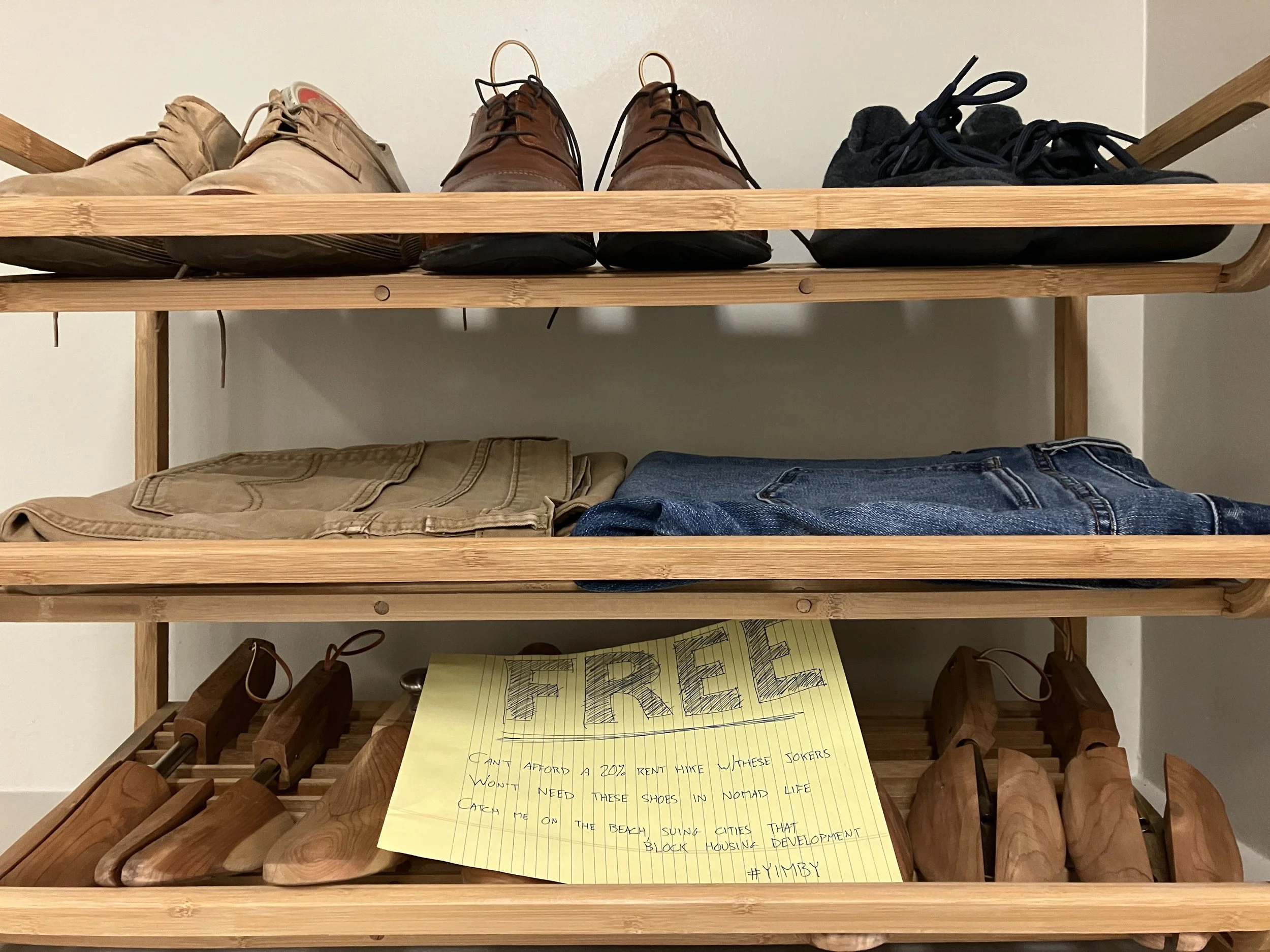
Can't have a shoe rack when your home is a Miata.

Can’t have a shoe rack when your home is a Miata

Something weird has happened in the housing market: short-term housing has become cheaper than long-term housing. All over the country, there are spare bedrooms and backyard sheds with monthly discounts on Airbnb. That’s how I’ve been living since May. I’ve saved thousands, even up and down coastal California, compared to what my former studio apartment in sonoran Arizona would have cost me. The ADU I just rented in El Paso was only $925.

Yes, the freedom is nice. I do not miss having a landlord, and you’re kidding if you think I’m taking a 30-year mortgage at these prices. But there is a day every month when I can’t leave my car. And there are entire months, depending on the layout and my hosts and their pets, when I can’t cook or use the bathroom at night. There’s a lot to be said for having a home.

California started this crisis, and it needs to fix it. That’s what motivated me to come work here. After a year in and out of the state, though, I can’t help but feel like Californians forget there are 49 other states affected by its housing crisis too. Being less equal than anywhere west of Louisiana, the state codifies an eleven-syllable term for equality and calls itself a leader. Housing elements are a lot of labor and bickering and bureaucracy for a half-million pages that aren’t real-world housing, and I can’t say what good they are unless they just legalize housing. (Thank you, Alameda.)

I’m done posting every week for a while. California law is too much. There will still be a housing shortage after Bay Area housing elements come due next week, I’m busy tracking where the builder's remedy might apply, and I’ve got lawsuits to prepare. You’ll hear about them next time I post.


What Good Is the Law If It Makes People Homeless?

I’m posting from the hip after relocating from Los Angeles to Phoenix to Tucson to Berkeley over the last week. Got to visit old friends and their new kids, but little time to write a blog post. Hashtag, nomad life. Buckle in.

property rights are for everyone

Last week, I wrote that property law should be intuitive. Let’s explore this theme a little further.

Many of us share an intuition that people should be free to do what they want, short of harming others. Outside the specific context of housing, I’m not interested in what’s “harm” and what’s not. Whatever “harm” is, most people don’t—shouldn’t—care about things that don’t cause it.

In legalese, there’s a fancy Latin phrase for this concept: “sic utere tuo ut alienum non laedas.” (E.g., Vill. of Euclid v. Ambler Realty Co. (1926) 272 U.S. 365, 387; Green v. Gen. Petrol. Corp. (1928) 205 Cal. 328, 335.) I don’t know Latin, and I don’t know what this literally means. But Lexis can identify 1,154 appellate cases that quote it, and I’d wager it’s in most property-law textbooks. In lay terms, it means you can do what you want, as long as you don’t harm others.

Legally, home is a place where the law especially presumes that you can do what you want, and don’t harm others. We all live somewhere. This is why American law confers special legal protections on the home. At common law, “burglary” was specifically defined as breaking and entering someone else’s home. The Fourth Amendment specifically prohibits unreasonable searches and seizures of people’s “houses.” The Internal Revenue Code provides many tax benefits to homeowners. “In our tradition, the State is not omnipresent in the home.” (Lawrence v. Texas (2003) 539 U.S. 558, 562.) Shelter is a human need, and it’s humane to protect people in their homes.

Please, tell me again how hard you worked to buy your home in the ‘80s.

We don’t have to have tent cities. We just tolerate the policies that cause them. Though we still honor the home in some legal contexts, zoning law treats it as a special privilege rather than an equal right. This is new: the government hasn’t always suppressed the supply of housing. Plenty of civilizations, including America, have managed to house substantially all of their citizens. There’s no inherent reason home prices should outpace median income, as they have over the last generation.

Zoning Isn’t God’s Will

I talk to a lot of housing activists, and a common theme I notice is acquiescence in zoning law. It’s the playing field today, but we don’t have to accept it. Over and over, I hear questions about whether it’s legal for cities to impose x constraint on y-sized parcels in z zoning districts. (Often, the questions necessitate more prepositional phrases and abstractions than that.) The questions I want to hear are about why it’s legal to prohibit home construction at all.

No one would accept the premise of modern zoning as applied to any other basic human need. If the government made people choose between buying a single-family home barrel of apples or no home apples at all, there would be riots. This is exactly what minimum lot-size regulations do. And yet we tolerate a rigged housing “market” that does cause mass homelessness, and would cause mass starvation if applied to the grocery market.

A legal regime that impedes homefulness, without a clear health-and-safety reason, is illegitimate. Neighbors aren’t nuisances. I just spent a month living down the street from Skid Row; don’t talk to me about “the blessings of quiet seclusion” unless you own a secluded ranch. (Contra Vill. of Belle Terre v. Boraas (1974) 416 U.S. 1, 9.) We’ve inherited a regime that privileges legacy homeowners to ban other people’s homes. This regime is immoral, and it’s our duty to dismantle it.

Property Law Should Be Intuitive

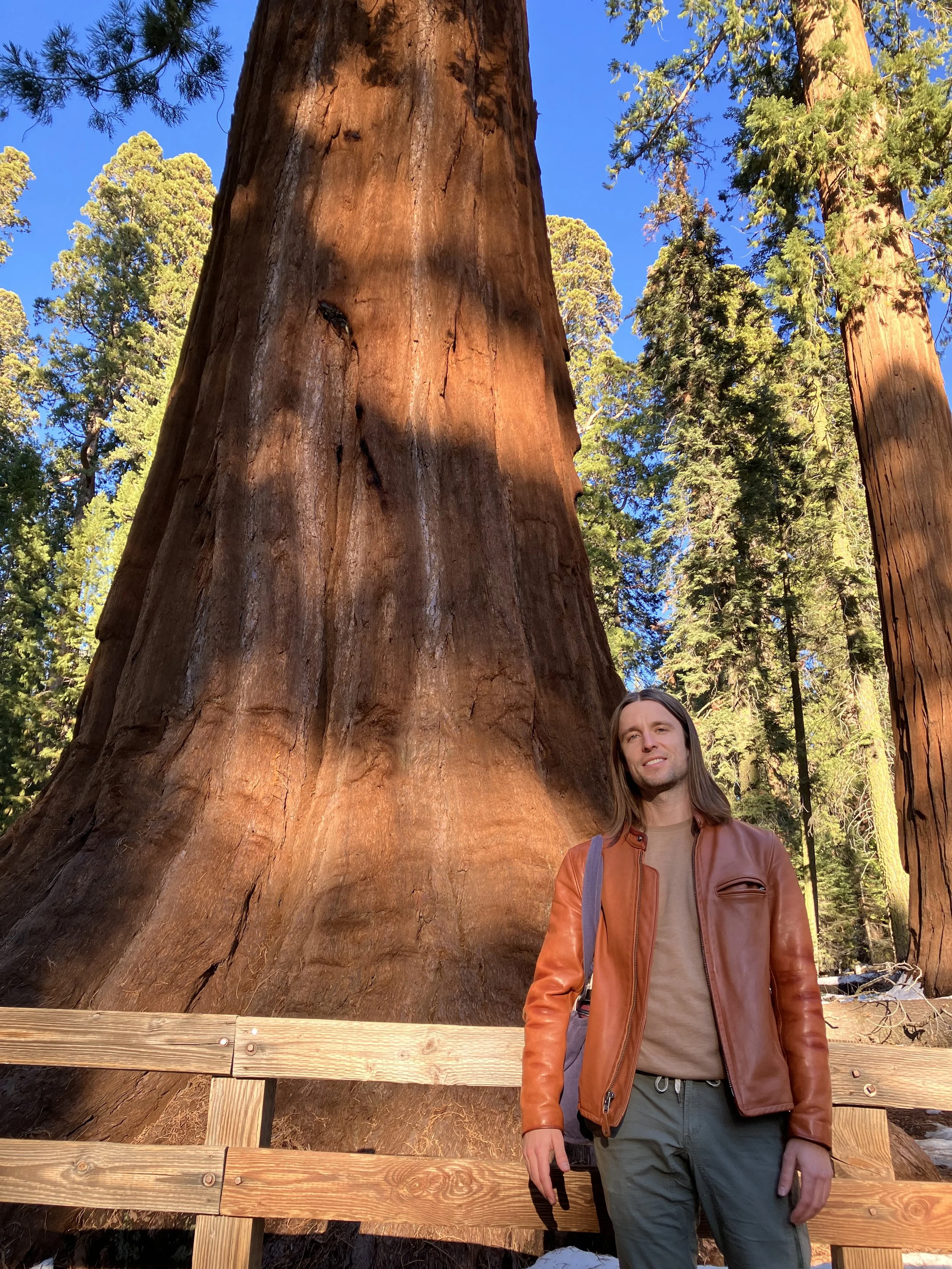
Hope everyone had a restful long weekend. I went on a day trip to Sequoia National Park to look at giant 2,000-year-old trees:

This tree weighs approximately one hundred elephants.

These trees are survivors. They evolved in the flammable western Sierra; sequoia seeds can only sprout in charred soil. It works magnificently. Several sequoias alive today are older than most of the world’s religions.

Even so, climate change is causing too much fire even for these colossal conifers. In 2020, one fire killed more than a tenth of all the sequoias there were. We’re going to lose the rest of them if we don’t stop burning dead dinosaurs. 

If we’re going to stop burning dead dinosaurs, most of us will need to resume living in cities where people can walk. But first, a quick ask.

Giving Tuesday

I’ll make this short. It’s Giving Tuesday, and YIMBY Law needs your help to fight bad laws that strangle housing production, price vulnerable people out of their homes, and encourage unsustainable living patterns. I am, so far, the only lawyer on staff. I’m working for a teacher’s salary, in part so I face the same housing-cost burden that teachers face, and in part so YIMBY Law can hire more attorneys for me to work with. I can’t do this alone.

Please consider donating to YIMBY Law this holiday season. Thank you for your generosity. Now back to our regular programming.

On Property, the Common Law, and Zoning

Let’s be blunt: it’s stupid that walkable cities aren’t legal. It wasn’t so long ago that they were. America once had property law with walkable cities, long before it had property law without them.

Property law isn’t as old as the sequoias—nor as old as democracy in Mesoamerica—but it’s a survivor in its own right. American courts observe legal principles dating back not just to the Constitution—the “I’m Just a Bill” way that statutes are born—but, earlier still, to something known as the “common law.” The common law informs most of what we intuitively think of as “property law.”

No one made the common law. Medieval English judges developed it slowly, case by case, without statutes, over hundreds of years. It’s a bottom-up system that’s still evolving today.

It’s strange to me what gets written about as “property law” and what it doesn’t. I noticed this in a pair of New York Times articles last weekend. 

The first story, about a court case in rural Wyoming, shows how wealthy private ranch owners are fencing ordinary hunters out of public land. It’s explicitly about property law. The hunters have organized themselves, and they have a compelling court case. 

The second story, on how Americans are increasingly aging alone, has just as much to do with property law. There’s a very important fact that the article recognizes, albeit barely: zoning is the reason there are no smaller, more neighborly homes for older Americans to move into. A clear injustice, but unlike the Wyoming case, no one’s talking about a lawsuit.

I suspect the second article’s inattention to property law has something to do with zoning not being intuitive. The Wyoming case is interesting because it appeals to our intuition that public land should be accessible to the public. But a generation forced to age in isolation, because minimum lot-size regulations skew the housing market? How lonely, and how sad that we shrug at the stupid laws enforcing the loneliness.

So I am appealing to our intuition about time: property law is older—more of a survivor—than zoning. There are no “property rights” in zoning, a/k/a Herbert Hoover’s racist pet project from the 1920s. Zoning is ahistorical, and we can safely cancel it. Then we can ask more interesting questions, such as: how to reincorporate older and more sequoia-friendly Mesoamerican land-use principles into our common law? 

For now, we need to stop making apartments illegal.

We Think We’re Right About CEQA Exemptions

Two weeks ago, we argued that builder’s remedy projects may use certain CEQA exemptions, regardless of zoning-consistency requirements, because zoning isn’t “applicable” to builder’s-remedy projects. (E.g., CEQA Guidelines § 15332; cf. Harroman Co. v. Town of Tiburon (1991) 235 Cal.App.3d 388, 394–97.)

Great news! There’s another, better case to support this theory. (See Wollmer v. City of Berkeley (2011) 193 Cal.App.4th 1329, 1347–50 [holding that “zoning standards are not ‘applicable’” under CEQA when “waived” by operation of density bonus law].) Affordable-housing developers, ask your CEQA lawyer if Wollmer is right for your builder’s-remedy project.

CEQA: What's Up With That?

Happy Friday. We’re doing a doubleheader this week because I wrote too much for Tuesday’s post about where the builder’s remedy will apply in the Bay Area. Today, an introduction to CEQA and the key takeaway for builder’s remedy projects.

In the Name of the Environment

Here at YIMBY Law, we like the environment. We’re affiliated with Urban Environmentalists, a part of the YIMBY Action network that supports infill housing specifically because of its environmental benefits. (In six words: walking doesn’t pollute, and driving does.) 

Coastal California is rightly famous for its climate: it’s one of the few places on Earth where humans (almost) never need to heat or cool their homes to live comfortably. Heating and cooling both pollute too. So it’s a shame that so many places in California make it illegal to build homes for people who would love to live in this magical climate if only it didn’t cost a million dollars.

The California Environmental Quality Act was enacted in 1970 out of a desire to preserve the State’s environmental resources. It’s a nice idea. It’s also a ghastly complicated law.

At an extremely basic level, CEQA mandates environmental review for any “project,” defined for our purposes as the issuance of a permit for any “activity which may cause either a direct physical change in the environment, or a reasonably foreseeable indirect physical change in the environment.” (Cal. Pub. Res. Code § 21065(c).) There’s a tangle of law about what is and isn’t a “project,” what is and isn’t exempt from CEQA, and what kind of and how much environmental review is and isn’t required for different projects. 

When CEQA requires environmental review, and sometimes even when it doesn’t, it can generate litigation. Litigation can delay a project for years, or block it forever. To be sure, that’s a good thing when the project would be a toxic asbestos dump in a residential neighborhood. But we think it’s a bad thing when the project is missing-middle homes in a residential neighborhood.

CEQA has become a frequent tool of abuse for special interest groups, such as anti-housing activists, with a nonenvironmental axe to grind. In 2015, the law firm Holland & Knight published a report finding that 4 out of 5 CEQA lawsuits against construction projects challenged infill development—the environmentally friendly kind—as opposed to the kind of “greenfield” developments that exacerbate urban sprawl.

I have my own CEQA anecdote. The first case I ever litigated was against the San Diego Transportation Association, which invoked CEQA to try stopping San Diego from issuing new taxi permits. At the time, taxi drivers had to pay the Association’s taxi lords to lease the permits the Association had hoovered up under the city’s old medallion scheme. I represented a pair of immigrant taxi drivers who wanted their own permits so they could feed their families with the money they were then paying to the taxi oligopoly. (The Association called me and my co-counsel “cheap ambulance chasers” in a court filing for daring to represent the taxi drivers. The Association lost that motion.)

A CEQA litigation target for V-8 taxi owners.

The Association argued that the city needed to do more environmental study, even though new permits could only be issued to drivers with low-emission hybrid cars, while the Association’s existing permits were grandfathered to allow gas-guzzling Crown Victorias. The Association’s environmental theory was bunk, and they ultimately lost, but the case took the better part of a year to resolve. 

Lawyers all over California have similar stories to tell. CEQA is a well-known problem in the housing-law community, but it’s politically sensitive and therefore hard to fix. Reforms have been proposed, but with limited success.

Talk to a CEQA Lawyer

I’m not a CEQA lawyer, and I’m learning how this complex statute regulates housing along with the rest of you. For now, any CEQA advice I can give is about as good as a podiatrist’s advice on a heart murmur. So, builder’s remedy applicants should consult a CEQA lawyer for the best chance of seeing their projects succeed.

More on CEQA next week. Have a great weekend.