CEQA: What's Up With That?

Happy Friday. We’re doing a doubleheader this week because I wrote too much for Tuesday’s post about where the builder’s remedy will apply in the Bay Area. Today, an introduction to CEQA and the key takeaway for builder’s remedy projects.

In the Name of the Environment

Here at YIMBY Law, we like the environment. We’re affiliated with Urban Environmentalists, a part of the YIMBY Action network that supports infill housing specifically because of its environmental benefits. (In six words: walking doesn’t pollute, and driving does.) 

Coastal California is rightly famous for its climate: it’s one of the few places on Earth where humans (almost) never need to heat or cool their homes to live comfortably. Heating and cooling both pollute too. So it’s a shame that so many places in California make it illegal to build homes for people who would love to live in this magical climate if only it didn’t cost a million dollars.

The California Environmental Quality Act was enacted in 1970 out of a desire to preserve the State’s environmental resources. It’s a nice idea. It’s also a ghastly complicated law.

At an extremely basic level, CEQA mandates environmental review for any “project,” defined for our purposes as the issuance of a permit for any “activity which may cause either a direct physical change in the environment, or a reasonably foreseeable indirect physical change in the environment.” (Cal. Pub. Res. Code § 21065(c).) There’s a tangle of law about what is and isn’t a “project,” what is and isn’t exempt from CEQA, and what kind of and how much environmental review is and isn’t required for different projects. 

When CEQA requires environmental review, and sometimes even when it doesn’t, it can generate litigation. Litigation can delay a project for years, or block it forever. To be sure, that’s a good thing when the project would be a toxic asbestos dump in a residential neighborhood. But we think it’s a bad thing when the project is missing-middle homes in a residential neighborhood.

CEQA has become a frequent tool of abuse for special interest groups, such as anti-housing activists, with a nonenvironmental axe to grind. In 2015, the law firm Holland & Knight published a report finding that 4 out of 5 CEQA lawsuits against construction projects challenged infill development—the environmentally friendly kind—as opposed to the kind of “greenfield” developments that exacerbate urban sprawl.

I have my own CEQA anecdote. The first case I ever litigated was against the San Diego Transportation Association, which invoked CEQA to try stopping San Diego from issuing new taxi permits. At the time, taxi drivers had to pay the Association’s taxi lords to lease the permits the Association had hoovered up under the city’s old medallion scheme. I represented a pair of immigrant taxi drivers who wanted their own permits so they could feed their families with the money they were then paying to the taxi oligopoly. (The Association called me and my co-counsel “cheap ambulance chasers” in a court filing for daring to represent the taxi drivers. The Association lost that motion.)

A CEQA litigation target for V-8 taxi owners.

The Association argued that the city needed to do more environmental study, even though new permits could only be issued to drivers with low-emission hybrid cars, while the Association’s existing permits were grandfathered to allow gas-guzzling Crown Victorias. The Association’s environmental theory was bunk, and they ultimately lost, but the case took the better part of a year to resolve. 

Lawyers all over California have similar stories to tell. CEQA is a well-known problem in the housing-law community, but it’s politically sensitive and therefore hard to fix. Reforms have been proposed, but with limited success.

Talk to a CEQA Lawyer

I’m not a CEQA lawyer, and I’m learning how this complex statute regulates housing along with the rest of you. For now, any CEQA advice I can give is about as good as a podiatrist’s advice on a heart murmur. So, builder’s remedy applicants should consult a CEQA lawyer for the best chance of seeing their projects succeed.

More on CEQA next week. Have a great weekend.


These 33 Zoning Codes Are Getting Suspended

Happy Election Day. We can finally project a zoning holiday in 33 Bay Area jurisdictions that haven’t submitted a draft housing element to the State.

The Zoning Holiday Is Coming to These Bay Area Jurisdictions

February will kick off a zoning holiday in Bay Area cities that fail to adopt a compliant housing element. With less than 90 days to go, it’s too late for 33 cities and counties that haven’t filed a draft with the State. That’s because the builder’s remedy applies to cities that haven’t “adopted” a housing element, and the statutes further prohibit the “adoption” of a housing element before the State has had 90 days to review it. (Cal. Gov. Code §§ 65589.5(d)(5), 65585(b)(1).)

A preview of the builder’s remedy in the Bay Area

Homebuilders, take note: American Canyon, Belvedere, Burlingame, Cloverdale, Cotati, Cupertino, Daly City, Fairfax, Half Moon Bay, Healdsburg, Larkspur, Martinez, Napa, Newark, Novato, Pacifica, Palo Alto, Piedmont, Pinole, Pittsburg, Pleasant Hill, Richmond, Rio Vista, Ross, San Anselmo, San Rafael, Vallejo, and unincorporated Alameda, Contra Costa, San Mateo, Santa Clara, Solano, and Sonoma Counties did not submit a draft housing element to the State by November 2. Unless the State dramatically expedites its review process when they do submit, these jurisdictions will not be able to enforce their zoning codes against affordable housing projects on February 1. 

More places are likely to join these 33 in builder’s-remedy jeopardy as the State rejects some drafts that are currently under review. We encourage interested builders to watch the State’s compliance tracker as February 1 approaches.

***

We’ll leave this exciting news here for today. Look for another post on Friday to begin our CEQA coverage.


Who’s Afraid of Some Extra Height?

Boo! Happy Halloween to every city that’s terrified of tall apartment buildings. This week: on Steinbeck, Santa Monica, and how to “vest” a builder’s-remedy project.

The Streets of Wrath

I’m nomadic: it’s cheaper than renting. (More on that in a future post.) I spent the weekend relocating from San Francisco to Los Angeles, where I’ll stay for the month of November. On the drive down the 101 past Monterey Bay, there are highway signs memorializing the late author and Salinas native John Steinbeck.

Steinbeck’s most famous work, The Grapes of Wrath, is a novel about the Great Depression. During the Depression, when unemployment peaked at 25%, out-of-control deflation drove desperate farmers to destroy their crops while millions of Americans went hungry. There’s a passage about this moral fiasco in The Grapes of Wrath:

The works of the roots of the vines, of the trees, must be destroyed to keep up the price, and this is the saddest, bitterest thing of all. Carloads of oranges dumped on the ground.… [M]en with hoses squirt kerosene on the oranges…. A million people hungry, needing the fruit—and kerosene sprayed over the golden mountains. And the smell of rot fills the country.… Dump potatoes in the rivers and place guards along the banks to keep the hungry people from fishing them out.…

There is a crime here beyond denunciation…. There is a failure here that topples all our success.… [C]hildren dying of pellagra must die because a profit cannot be taken from an orange.… The people come with nets to fish for potatoes in the river, and the guards hold them back; they come in rattling cars to get the dumped oranges, but the kerosene is sprayed. And they stand still and watch the potatoes float by … watch the mountains of oranges slop down to a putrefying ooze; and in the eyes of the people there is the failure; and in the eyes of the hungry there is a growing wrath. In the souls of the people the grapes of wrath are filling and growing heavy, growing heavy for the vintage.

I think about this everywhere I see people living in tents and cars on the streets between vacant office buildings. Not even work pays the rent anymore. I wonder what Steinbeck would have written about today’s housing crisis. The economics are a little different—we’ve got high prices mitigated by plentiful jobs, for now—but wasted shelter is just as tragic as wasted food.

With that, let’s turn our attention to Santa Monica, a city that wants people to work but not live there.

Santa Monica vs. the Builder’s Remedy

Last week, YIMBY Law hosted a talk with Los Angeles attorney Dave Rand, who’s working on several builder’s-remedy projects in Southern California. The one that’s getting the most attention is a 15-story high-rise in Santa Monica with 2,000 units, hundreds of which will be affordable to people who don’t make six figures. This should be a huge relief for a job-rich community where the median home fetches $2 million, easily more than 20 times what most jobs pay.

Sadly but predictably, the city has vowed to block this and 14 other apartment projects that could house Santa Monica’s priced-out service workers. Teachers and firefighters don’t expect mansions, and for Santa Monica’s gentry, that seems to be exactly the problem. Serve us coffee, they imply, but don’t come here looking for a place to sleep. Just where do these aristocrats expect their baristas to live?

As Dave tells it, the builder’s remedy is testing whether cities are too afraid of “a little more height” to make themselves as affordable as they say they want to be. Santa Monica is failing the test so far, and we can’t wait for the city to explain itself in court.

How to “Vest” a Builder’s-Remedy Project

We’re going to cover the builder’s remedy in this space as long as people have questions. This week, let’s look at the first step in the process, what’s known as a “preliminary application” under the Housing Accountability Act (“HAA”).

Under the HAA, a preliminary application freezes existing development standards for any housing development project that lists seventeen relatively simple criteria. (Cal. Gov. Code §§ 65589.5(o)(1), 65941.1(a).) That—locking in the right to build—is what HCD called “vest[ing]” in its October 5 letter to Dave. That’s the kind of legal assurance builders need to develop the homes the rest of us need. It’s a scandal that cities would litigate this.

As we explained last week, the builder’s remedy creates a zoning holiday in cities without a compliant housing element. (See id. § 65589.5(d)(5).) So, when a property owner files a preliminary application with the builder’s remedy in effect, they “vest” the right to take advantage of the zoning holiday. It doesn’t matter if the city achieves compliance later, as HCD certified Santa Monica did on October 14. Those thousands of new homes are now vested, whether Santa Monica likes it or not. 

The preliminary application is available as a standard form on the California Department of Housing and Community Development’s website. It requires little more than a site plan, and costs $10,000–$15,000 to file with professional help (which we advise). Applicants then have six months to complete a full application. We won’t call it cheap, but it’s less expensive than the legal delays and uncertainties that inflate the cost of most new buildings.

***

Next week, we’ll address what we anticipate is the main legal obstacle for most builder’s-remedy projects: the California Environmental Quality Act (“CEQA”). Until then, here’s The Boss with something to rage against.

Why the California "Builder's Remedy" Means What It Says

We’re a week closer to the housequake. This week: why we work with untested law, a plain reading of the builder’s remedy, and a special invitation.

“No One … Underst[ands] the Full Scope” of Housing Reform

Over the weekend, Ezra Klein wrote in depth about Los Angeles’s failure (so far) to build “affordable” housing at less than $600,000 per unit. It’s a great article. In 2016, Los Angeles voters approved $1.2 billion to construct 10,000 new homes. Six years later, just a third of those homes have been built, at a cost north of $2 billion (the city doesn’t fund all of it), and the slow progress is being debated in the Los Angeles mayor’s race. Klein’s article raises excellent questions about why affordable housing is so hard.

The most important part of the affordable-housing equation is time. No one can build a home overnight. Even if there were infinite land and no laws to delay housing production, it would still take time to line up the people and materials builders need to make a new home. Then, if there’s no supply crunch, homes become cheaper with age, as mortgages get paid off and original owners vacate for newer buildings. Jane Jacobs wrote a chapter on this phenomenon in her magnum opus The Death and Life of Great American Cities (see ch. 10). And that’s to say nothing of the fitful way funds are Frankensteined together, which Klein covers in his article.

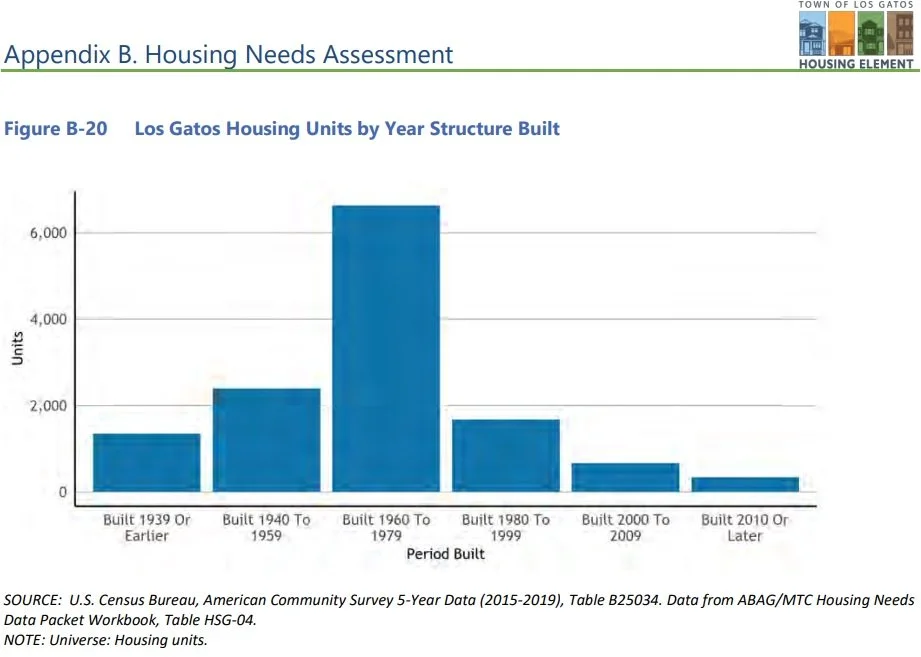
Unfortunately, we are in a supply crunch: see how home construction crashed after the Great Recession, for one thing. That would be bad enough, but the roots of the supply crunch are deeper than that. California cities’ housing elements report a home-production boom shortly after the baby boom, and close to nothing since the advent of downzoning in the 1970s.

A middle finger to modern generations, from Los Gatos’s draft housing element (p.B-23)

Today’s supply crunch is the product of a half-century of nimby policy. That’s the main problem: we can’t make up for fifty lost years in the next five. Still, housing is a basic human need, and we have to make up for as much lost time as we can. That’s the point of all the prohousing reforms that the YIMBY movement has recently gotten passed.

Klein nods at these reforms toward the end of his article, and this quote jumps out: “no one … underst[ands] the full scope” of California’s new housing laws. They’re all a work in progress, and much remains to be litigated. But it’s clear the new laws are YIMBY in spirit. That will matter when courts interpret their letter.

The Builder’s Remedy Means What It Says

One of the reforms we’re promoting at YIMBY Law is the builder’s remedy. You’ve likely read about it, and we’re getting lots of questions about how it works.

Let’s start this week with the first rule of statutory construction: read the statute. The builder’s remedy was enacted in 1990 as an intentional addition to the Housing Accountability Act (“HAA”). The remedy is available to certain affordable* developments, unless a city proves one of five defenses:

A local agency shall not disapprove a[n affordable] housing development project … including through the use of design review standards, unless … :

(1) The jurisdiction has adopted a [compliant] housing element … and the jurisdiction has met or exceeded its [RHNA]** for the planning period ….

(2) The housing development project … would have a specific, adverse impact …‌. Inconsistency with the zoning ordinance or general plan land use designation[ is not a “specific, adverse impact”].

(3) … [S]tate or federal law [requires disapproval] ….

(4) The … land [is] zoned for agriculture or resource preservation*** … or [needs] water or wastewater facilities ….

(5) The … zoning ordinance and general plan [required disapproval] on the date the application was deemed complete, and the jurisdiction has adopted a [compliant] housing element ….****

(Gov. Code § 65589.5(d) [italics added].) Again, the default rule is that the builder’s remedy applies, unless the city establishes one of these five defenses.

  • “Affordable,” for builder’s-remedy purposes, refers to the way California law classifies households as “lower” (well below median) or “moderate” (near median) income. The builder’s remedy applies to projects where either 20 percent of the homes are affordable to lower-income households, or else all of the homes are affordable to moderate-income households.xt goes here

  • “RHNA” is short for “regional housing need allocation,” determined with reference to “income category.” (Cal. Gov. Code § 65589.5(d)(1).) Mixed-income projects can overcome this builder’s-remedy defense if the city is behind its RHNA in any of the project’s income categories. (Ibid. [enabling HCD to “calculate[]” RHNA progress]; see also id. § 65400(a)(2)(B) [requiring cities to report progress annually].)

  • This defense also requires that the land is “surrounded on at least two sides by land being used for agriculture or resource preservation.” (Id. § 65589.5(d)(4).)

  • Cities may not invoke this defense on sites in their housing-element site inventory. Cities with bad site inventories may not invoke this defense on any residential site. (Id., subd. (d)(5)(A)–(C).)

The main builder’s-remedy defense is when local zoning prohibits the project and the city has a compliant housing element. (Id., subd. (d)(5).) Zoning often prohibits projects. Housing-element law wasn’t well-enforced in the past, but that’s changing. Over 90% of cities in Southern California missed last year’s housing-element deadline, many missed it again after the Legislature extended that deadline, and we’re projecting more than half of Bay Area cities will miss their upcoming deadline on January 31. That will take away the main defense to the builder’s remedy, meaning lots of cities without zoning.

The builder’s remedy means what it says. HCD confirmed this in an October 5 letter supporting a 2,000-home builder’s-remedy project in Santa Monica. We anticipate cities will argue that another HAA provision creates a loophole for “objective … development standards,” but the second rule of statutory construction is: keep reading the statute. The “fundamental task … is to determine the Legislature’s intent so as to effectuate the law’s purpose.” (San Jose Unif. Sch. Dist. v. Santa Clara Cnty. Office of Educ. (2017) 7 Cal.App.5th 967, 975 [quoting People v. Cornett (2012) 53 Cal.4th 1261, 1265].) And the HAA goes on to say that its “development standards” clause “shall not be construed in a manner that would lessen the restrictions imposed on a local agency, or lessen the protections afforded to a housing development project” by the builder’s remedy. (See Cal. Gov. Code § 65589.5, subds. (f)(1), (o)(5).) In other words, the “development standards” clause isn’t a defense to the builder’s remedy: it’s only for cities that have a builder’s-remedy defense in the first place.

A Special Invitation

Join YIMBY Law on Thursday at 1pm Pacific for a conversation with Dave Rand, the lawyer for the Santa Monica builder’s-remedy project. Email me for the registration link, and look forward to seeing you then.

An Introduction, a Housequake, and Zombie Easements

Welcome back to the YIMBY Law Journal! It’s been a while, so let’s catch up.

Who’s This?

I’m Keith, and I’ve been managing YIMBY Law’s work on the Campaign for Fair Housing Elements since April. I’ll be writing here on Tuesdays as often as I can. 

I’m a lawyer with experience in public-interest litigation. Before YIMBY Law, I worked for seven years at the nonprofit Institute for Justice, where I helped set a few precedents. IJ taught me that every great case tells a story. I’ve met so many people in my career, and heard too many stories about land-use bureaucracy making life hard. I came to YIMBY Law to help change that.

Bad laws change when good stories persist. My signature case at IJ was a challenge to Nashville’s home-business ban, where I represented a record producer and a hairstylist who wanted to work from home. Public comment was against us in 2016, but my clients and I stuck to our beliefs, and by early 2020 we’d built enough public support for a change.org petition to go viral. Then the pandemic hit, everyone had to work from home all of a sudden, and Nashville repealed the ban (sort of: the case is still ongoing). I’m confident nothing would have changed if my former clients hadn’t made their stories public so many years ago.

Housequake!

Let’s turn to a story about lots of new homes coming to the Bay Area soon.

California law requires every city to produce a document called a “housing element.” In simple terms, the state assigns every city a number of new homes to plan for, and a good housing element shows how the city will make those homes legal to build. Some cities write bad housing elements, and the state Department of Housing and Community Development (“HCD”) can disqualify them if they’re bad enough. One potential consequence for a disqualified housing element is called the “builder’s remedy.”

The builder’s remedy preempts all local zoning for certain affordable housing projects. This removes a huge barrier to home construction, which is why we’re so excited about it. But the builder’s remedy only applies in cities without HCD-certified housing elements, so it’s not available in most places, most of the time.

Every eight years, California cities have to update their housing elements. And with new ramped-up housing goals set by the state, cities that are clinging to old, exclusionary zoning rules are struggling to convince HCD that they can meet their fair share. Most Southern California cities missed their deadline, and Redondo Beach now stands to gain 2,290 new homes thanks to the builder’s remedy. In the Bay Area–specifically anywhere in Alameda, Contra Costa, Marin, Napa, San Francisco, San Mateo, Santa Clara, Solano, or Sonoma Counties–the deadline for new housing elements is January 31. This deadline is now close enough that we can predict dozens of Bay Area cities will miss it.

That means Bay Area homebuilders can expect cities without zoning on February 1. HCD recently confirmed this timing in a letter to East Bay for Everyone’s Kevin Burke. San Francisco is scrambling.

We’re calling for a housequake to make the most of this zoning jubilee. If you have a potential builder’s remedy project, let us know, and get ready to tell your zoning authorities to shut up already, damn.

Zombie Easements

Last week, we joined the California Renters’ Legal Advocacy and Education Fund on an amicus brief in support of a 450-home project in Riverside. The city has cleared the project, and is even counting on it in its housing element. But a neighboring grocery store got a judge to block the project, based on a 1979 easement over one corner of the project site.

Easements are a type of private property restriction. The easement in this case gives the grocery store “ingress and egress” rights over a small strip of road so that delivery trucks can drive across the project site and get to the back of the neighboring store. Grocery stores and apartment complexes work these things out all the time, and we don’t see that the project developer in Riverside is planning to block the store’s access. Instead, the grocery store persuaded the trial court that the easement prohibits any apartments anywhere on the site. The project developer has appealed.

We and CaRLA weighed in to remind the Court of Appeals that there’s a strong public interest in getting homes built, and that the trial court’s injunction blocking 450 homes harms the public interest. What’s more, caselaw warns against interpreting “nonexclusive” easements (which this easement is) to prohibit entire land uses (as the trial court’s injunction does). But that’s effectively what the trial court did in Riverside, and we hope it gets reversed so Riverside can gain 450 new neighbors.

Many easements are useful: they help reconcile private property with public infrastructure, among other things. But as the Riverside case shows, easements can also be turned into anti-housing zombies. That’s not what easements are supposed to do, and we’re watching this case so that California doesn’t suffer an outbreak of zombie easements.

In a world of madness, the sane strategy is to go insane

Most of the time, the stalled housing projects we encounter at YIMBY Law are pretty straightforward. The local law allows the housing and the state law requires the city to approve it, the city knows this, or, accepts it once we point it out, but the immediate neighbors refuse to believe it, or believe the law is unjust and ask the City Council to fight it. Through a combination of grassroots organizing and threatening letters, everyone gets on the same page and the housing is approved. 

Sometimes, however, we find ourselves beyond the looking glass, sinking into a well of madness, our minds bending into shapes known only to an evil, otherworldly geometry. And this is where we found ourselves contemplating Los Angeles’ reaction to Akhilesh Jha’s proposal to build 7 stories, 60 apartments, 60 parking spaces and one floor of retail at 5353 Del Moreno Drive in Los Angeles, California. 

The Los Angeles General Plan land use designation for 5353 Del Moreno Drive is “Limited Commercial”. Among other things, Limited Commercial allows apartment buildings with a density of up to 1 unit per 400 square feet of the lot. So, on AJ’s, 20,000 sq ft lot, the general plan allows an apartment building of up to 50 apartments. (20,000/400= 50) In addition, the state density bonus allows another 17 units, for a total of up to 67 apartments. 

The zoning code, however, only permits a single family house, and, incidentally, a chinchilla farm. 

AJ submitted an application to the LA planning department to build a 60 unit apartment building, as described above. The LA Planning Department replied saying that the proposed density of 1 unit per 400 sq. ft. at 5353 Del Moreno Drive is not consistent with the zoning (see Attachment 1.1), so if he wanted to move forward with his project, he would need a zone change. 

No problem, AJ replied, the Housing Accountability Act, Gov. Code, § 65589.5(f)(4) states that “a proposed housing development project is not inconsistent with the applicable zoning standards and criteria, and shall not require a rezoning, if the housing development project is consistent with the objective general plan standards and criteria but the zoning for the project site is inconsistent with the general plan.” (emphasis added) My project is clearly “consistent with the … general plan standards,” so I do not need a rezoning. 

Well, said the LA Planning Department, that sentence only applies if the “... zoning for the project site is inconsistent with the general plan,” and the zoning at 5353 Del Marino (single family) is consistent with the General Plan designation (limited commercial). 

Wonderful, said AJ, to hear that the zoning is consistent with the General Plan. Given that my project is consistent with the General Plan, and the zoning is consistent with the General Plan, it sounds like my project is consistent with the zoning, and we can proceed. 

No, not at all, said the LA Planning Department. Your project is not consistent with the zoning, although it is consistent with the General Plan, and the Zoning is consistent with the General Plan, but the Zoning is not consistent with your project. 

What?

AJ wisely called YIMBY Law. 

LA Planning’s argument is basically that because the zoning allows a subset of what is allowed in the general plan, then the general plan and zoning are not inconsistent. It’s a maddening idea of “consistency” but it explains this apparent contradiction. 

LA Planning should have kept reading paragraph (f)(4) because the sentence after the one AJ initially cited still supports AJ’s project. It says that where the zoning is consistent with the General Plan, “the local agency may require the proposed housing development project to comply with the objective standards and criteria of the zoning which is consistent with the general plan, however, the standards and criteria shall be applied to facilitate and accommodate development at the density allowed on the site by the general plan and proposed by the proposed housing development project.” (emphasis added)

Cities therefore have no way out. If they think that the zoning for a site is consistent with their General Plan, they can only enforce the aspects of the zoning that facilitate the density allowed on the site by the General Plan. And if the city claims the zoning is inconsistent, then a project sponsor can basically ignore the zoning, and only look to the standards and criteria in the General Plan. 

We will be helping AJ build his apartment building, and maybe also a chinchilla farm. If you see any other examples of cities trying to avoid their duties under state law, let us know!

Attachment 1: Communications Between Planning Department Staff and Applicant

On Fri, Aug 7, 2020, 4:04 PM Justin Bilow <justin.bilow@lacity.org> wrote:

Hi AJ,

This email follows up on and summarizes information discussed during our call from Friday July 10, 2019.  Below is a summary of zoning information related to your proposed project at 5353 Del Moreno Drive (“Project”); information related to your questions about the Project’s SB330 Preliminary Application for vesting under Government Code Section 65941.1 (“Preliminary Application”); and contact information to assist you with pursing your later application for a development project.

1. The Preliminary Application Is Incomplete

The Project’s Preliminary Application for vesting under Government Code Section 65941.1 is not considered submitted because the Preliminary Application contains inaccurate information regarding the use of Density Bonus, and therefore does not contain all of the information required. The Preliminary Application states that the Project will seek Density Bonus incentives and bonus units for 60 residential units.  However, the site’s RA-1 zoning does not support a Density Bonus development because the existing zoning authorizes a single one-family dwelling. Additional density for the project may be sought through a Zone Change (LAMC 12.32 F) or Vesting Zone Change (LAMC Section 12.32 Q).

The Department seeks accurate and complete Preliminary Application information from the applicant at this early stage in order to, among other things: (1) give project applicants an opportunity to secure the earliest possible Preliminary Application submittal date through an early opportunity to correct and accurately submit all of the information required; (2) facilitate a smooth and expeditious development project application process because incorrect or incomplete information can cause unexpected delays or loss of vesting, (3) facilitate an applicant’s ability to maintain vesting rights during the next short development project application timeline — i.e., the 90-day period under Government Code Section 65941.1(d)(2) to submit information needed for the subsequent complete development project application; (4) provide an accurate basis upon which the City is required to evaluate any potential project revisions under Government Code Section 65941.1(c); and (5) avoid delays by facilitating an early accurate understanding about what standards, rules, and entitlement procedures apply to the project based on the information required by Government Code Section 65941.1.

Your requested findings under California Government Code Section 65589.5(j)(1) are not applicable to the Preliminary Application, and are therefore not required to determine that the Preliminary Application is incomplete.  The findings at Government Code Section 65589.5(j)(1) apply to the later development project application which is supposed to be submitted to the Department of City Planning within 180 calendar days after you submit a Preliminary Application with all of the information required.  See Government Code Section 65914.1(d). The later development project application would request specific development approvals through procedures, hearings, and findings specified by the Los Angeles Municipal Code.

2. The Site Requires A Zone Change For The Proposed Project

The site is zoned RA-1, but the Project is proposed at C1.5-1 development standards with 60 residential units.  As a consequence, the proposed Project requires the site to seek a Zone Change or Vesting Zone Change.

The site requires a zone change because the General Plan’s applicable Community Plan, here the Canoga Park - Winnetka - Woodland Hills - West Hills Community Plan (“Community Plan”), states that the site’s zone is consistent with the "Limited Commercial" land use designation.  Consistency is supported by: a) the Community Plan map, b) text in the “Plan Consistency" section on page 20 of the Community Plan, and c) Footnote no. 9 on the Community Plan Land Use Map relating to "Corresponding Zones."  Footnote 9 states the following in pertinent part:

“Each Plan category permits all indicated corresponding zones as well as those zones referenced in the Los Angeles Municipal Code (LAMC) as permitted by such zones unless further restricted by adopted Specific Plans, specific conditions and/or limitations of project approval, plan footnotes or other Plan map or text notations.”

Footnote 9 explains that each land use category permits the less intensive zones referenced by the LAMC, in addition to the more intensive corresponding zones listed on the face of the Community Plan land use map. The site’s zone-plan consistency is further explained by the City's hierarchy of less to more intensive zones found in LAMC Section 12.04-A, and a review of LAMC Sections 12.07 (RA zone) through 12.13 (C1.5 zone)....

Best Regards,

On Tue, Aug 11, 2020 at 5:09 PM Sarah Molina-Pearson <sarah.molina-pearson@lacity.org> wrote:

Hi Akhilesh,

Yes, the zone and land use designation are consistent. As I mentioned to you yesterday, I would like to continue to explore options for your project to move forward. Please feel free to reach out to me in the next week or two. If I receive any new information before then, I will make sure to let you know.