
The Chronicles of Californarnia

On π day, we predicted that at least ten cities would learn they’ve got more work to do on their housing elements. We were right about all ten (as of this afternoon, San Carlos, Walnut Creek, Colma, and Los Altos Hills hadn’t conspicuously posted their HCD rejection letters online).

It would be nice if HCD posted its review letters, too. But they’re busy, reviewing 539 often-thousand-page housing elements. Meanwhile, local governments are arguing with HCD in the press. That’s where we’re at, so let’s examine some of the confusion about who’s where with housing elements.

Trying the Hitch in the Poor Code

At 40,000 words, the housing-element law is longer than The Lion, the Witch and the Wardrobe. That’s a problem. A novel-length statute had better tell a novel-quality story about how local governments should plan for housing. The statute we have is a sprawling mess of word pollution.

DALL·E rendition of “housing aslan”

Housing elements waste everyone’s time tilting at windmills. The legislature could repeal the zoning enabling act, or at least set a minimum maximum density for urban regions; instead it has chosen to fight local bureaucracy with state bureaucracy. Site inventories must pretend to predict the future, when the future follows no plan. Housing advocates are relegated to playing Sancho Panza, counseling HCD’s regulators-errant to scrutinize countless sites in the hope that their local ínsulas might be ordered to legalize housing. In 54 years, this system hasn’t solved the housing crisis, and it’s reasonable to ask if it ever will.

If YOU’re Explaining, YOU’re Losing

It’s troubling that the system generates so many questions about procedure. Good procedures go largely unnoticed. Bad procedures steal attention from the substance of the law.

Since our last post, HCD published a compliance memo clarifying the procedures for adopting a housing element. (Gov. Code § 65585.) HCD reads the statute like we do. Local governments must submit at least one draft housing element for a 90-day review before they can adopt, and whichever housing element they adopt should have been reviewed by HCD. Housing elements should not be revised willy-nilly between review and adoption.

Section 65585 isn’t the only law on adopting a housing element. As we wrote in our last post, there’s a whole article of planning law governing general-plan revisions, which all housing elements are. Among other requirements, there’s supposed to be a “written recommendation” from the planning commission to the city council or board of supervisors (§ 65354), “at least one public hearing” (§ 65355), and a four-amendment annual limit (§ 65358, subd. (b)). 

As local governments scramble to block the builder’s remedy for fear of by-right affordable housing, HCD seems to be letting these more general requirements slide. To cite one example, HCD certified Oakland based on “modifications” that the Oakland City Council never voted to adopt. What happened was that Oakland “authorize[d] staff to make non-substantive changes” on p.6 of its adopting resolution (filed “January 32”). But any changes required to “achieve certification,” as Oakland intends, are necessarily substantive. To our knowledge, there wasn’t a hearing on these revisions. 

Berkeley, Glendale, La Habra, Santa Rosa, and surely others have had staff modify their adopted housing elements, too. That’s probably okay for correcting a typo. It isn’t legal for bringing a housing element into compliance. But we’re deep into arguments about procedure here—traditionally the province of nimby litigants trying to block change. We need change, and for that, we’re going to need a better system.

What’s Stopping the Priced-Out Majority?

According to the Terner Center, the majority of California renters are overpaying for housing: the housing “market,” thoroughly rigged by minimum lot-size requirements, no longer provides enough supply for the middle class to spend less than a third of its income on rent. One would expect a cost-burdened majority to have some political sway, and that does seem to be true in Sacramento—it’s also true in red-state capitals such as Billings and Tallahassee. So what’s the holdup here?

California’s political paralysis has much to do with 39 million people being divided, unevenly, into 539 local governments. Few of these are true cities, the time-tested kind who coalesce over centuries. Out of 482 incorporated cities—58 local governments are counties, and San Francisco is both a city and a county—370 were incorporated after 1900, and 199 were incorporated after World War II. Most are better described as municipal corporations, for they behave more like corporations than like real cities.

The real function of the housing-element law is to delegate the need for political courage from the state to these 539 municipal corporations. The problem is that corporations are cowardly. Being corporations, they’re more attuned to looking for loopholes.

Sausalito ain’t no Santorini

Take Sausalito, which voted on January 30 to adopt a housing element that it had only published the afternoon before. A traditional city, enacting any meaningful policy, would never. Sausalito’s rush to adopt a hastily rewritten housing element, in open fear of the builder’s remedy, ran roughshod over the spirit of Section 65585’s public-comment requirements. So why didn’t we sue them for curtailing public comment? Well … the literal requirement is to post any “subsequent” draft housing element “at least seven days before submitting” to HCD. (Gov. Code § 65585, subd. (b)(3) [italics added].) Sausalito found a loophole: it voted to adopt after one-day public comment, but complied with the letter of the law by waiting weeks to submit. 

If you’re going to have a 40,000-word statute, you’re going to have loopholes. Oh well. We sued Sausalito for other shenanigans.

Coda: Surf City Silliness

We aren’t wasting time on that federal lawsuit alleging “fraud” against the governor for saying there’s a housing crisis. There is a housing crisis. But here’s a nice OC Register interview on why that lawsuit is a waste of time.

There's No Such Thing as "Self-Certification"

By the end of the month, HCD will have issued findings on some two dozen cities’ housing elements. Administrative procedure is confusing, and housing elements confuse people. Confusing procedures invite shenanigans. We hear a lot of questions about “self-certification” especially, and the short answer is that it’s a legal way for cities to dare litigation. The long answer is the subject of today’s post.

So–before (guessing!) Goleta, Moraga, San Carlos, Walnut Creek, Colma, San Mateo, Clayton, Danville, Lafayette, and Los Altos Hills learn they’ve got more work to do—let’s look at the statutory roadmap to substantial compliance: what substantial compliance is, and the administrative procedures for achieving it.

“Substantial Compliance” Is a Question of Law

If you’ve read our Sausalito petition,you know that “[s]ubstantial compliance is question of law.” (Pet., ¶ 195.) There are no magic words in law, but the term “question of law” carries legal significance. It refers to the kind of question that only a court can decide. This matters because HCD is not a court. HCD is an administrative agency, and even though it has the duty to “determine whether [a] draft … substantially complies” with the housing-element law (Gov. Code § 65585, subd. d)), HCD’s “written findings” (ibid.) are not binding on courts.

For emphasis: only a court can ultimately decide whether a housing element “substantially complies” with state law. (Fonseca v. City of Gilroy (2007) 148 Cal.App.4th 1174, 1191.) HCD’s determinations are just that: determinations. The courts are free to disagree with HCD, and when they do, their judgments (mostly) control.

  • As with most legal questions, and too often in California, it’s complicated and it depends. There are bits and pieces of the housing-element law, such as the timelines for rezoning, that depend more on HCD’s compliance determinations than those of the courts. (See Gov. Code § 65583, subd. (c)(1)(A) [it’s complicated].) For builder’s-remedy purposes, though, the courts’ compliance findings matter more than HCD’s.

Thing is, most housing elements never get litigated. Few developers want to litigate, and there aren’t (yet) enough YIMBY lawyers to challenge all the bad housing elements. (If you’re a hotshot litigator who’s dissatisfied with modern land-use law, please consider joining us.) For the majority of housing elements, where no one seeks a court judgment, HCD’s compliance findings are simply the best available proxy for “substantial compliance.”

In court, “ ‘substantial compliance’ … means actual compliance in respect to … every reasonable objective of the [housing-element] statute.” (Fonseca, above, at p.1185; see also Camp v. Bd. of Supervisors (1981) 123 Cal.App.3d 334, 348 [a pamphlet doesn’t cut it].) Yes, the “actual” is italicized in the court opinions.

In other words, “substantial compliance” all depends on what the housing-element statute requires. The stronger requirements, like those for constraint removal and about nonvacant lower-income sites, put the burden of proof on the government. (E.g., Gov. Code §§ 65583, subd. (c)(3); 65583.2, subd. (g)(2); 65587, subd. (d).) Weak requirements, such as the requirement to “[a]ffirmatively further[] fair housing,” delegate to cities the task of deciding which actions have “meaning[].” (See Gov. Code § 8899.50, subds. (a)(1), (d).) That’s too bad about the weak requirements, but the strong requirements do debunk the myth that “substantial compliance” means “close enough” or “come on, they tried.” No! Every reasonable objective of Section 65583.2—the site-inventory statute—is a real requirement. (See Fonseca, at pp.1196–97.) And a court can (almost) always enforce those requirements, no matter HCD’s findings.

  • Don’t get us started on California’s statutes of limitations.

Don’t Confuse “Certification” with “Compliance”

Like we said, confusing procedures invite shenanigans. We’ve heard a lot of chatter about “self-certification,” i.e., the adoption of uncertified housing elements. As we’ve written elsewhere, certification isn’t at all equivalent to compliance.

A housing element is an element of a general plan. (Gov. Code § 65302, subd. (c).) There are general rules for adopting general-plan revisions; we won’t get into those here. What we’re talking about today are the special rules for revising a housing element. Those rules are in Section 65585 of the Government Code.

The key characteristic of the housing-element revision statute is that it’s an administrative procedure. Section 65585 mandates administrative review of every housing element. HCD is the reviewing agency, and every local government is required to either get certified by HCD or else explain why the local government believes HCD’s findings are wrong. We’re confident the statute requires at least that much.

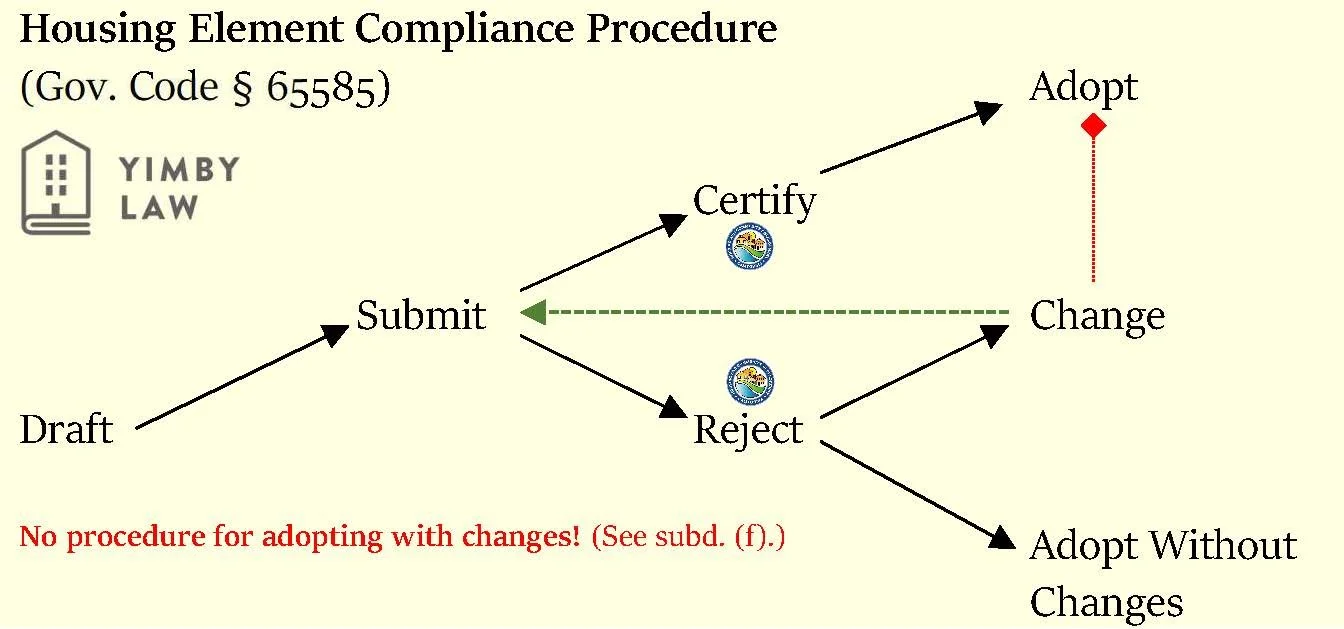
We read Section 65585 to require at least four distinct actions on the road to compliance: local governments must draft, submit, certify, and adopt. To “draft” is to post for public comment. (Subd. (b)(1).) To “submit” is to seek HCD review. (Ibid.) To “certify”—a term that isn’t in the statute, just fairly implied—is to provide “written findings” that a draft “substantially complies” with the housing-element law. (See subds. (d), (f)(2).) And to “adopt” is to enact in any manner provided by law. (Subds. (b)(1), (e), (f)(2), (g); see id. §§ 65350 et seq.) These are necessary, but not sufficient, procedural conditions for compliance: substantial compliance is a question of law!

Most local governments get the first two procedures right. Things get dicey at and after the certification stage, where the intuitive ideal of “law” breaks down under a 40,000-word statute. We’ll put that problem aside for this paragraph. Obviously, HCD can certify a housing element. This creates a “rebuttable presumption” that the housing element is compliant. (Gov. Code § 65589.3.) Surprisingly to some, local governments can also adopt their housing elements “despite” HCD findings of noncompliance. (Id. § 65585, subd. (f)(2).) There’s just no presumption of validity without HCD certification. (Id. § 65589.3.)

The procedures for adopting an uncertified housing element are sadly too squishy. The governing provision is subdivision (f), and there’s a good argument that a local government, with HCD’s rejection in hand, may only take “one of the following actions”: either “[c]hange the draft … to substantially comply,” or “[a]dopt the draft … without changes.” (Gov. Code § 65585, subd. (f).) In practice, too many local governments to count have adopted their uncertified housing elements with changes. And we simply can’t sue them all.

We think the natural reading of Section 65585 provides for uncertified local governments to “change” their rejected housing elements by resubmitting for HCD certification before adopting. (Gov. Code  § 65585, subd. (f)(1).) The statute clearly authorizes that approach. And we respect that it is procedurally (though not substantially) compliant to adopt a rejected housing element “without changes.” (Id., subd. (f)(2).) But we cannot see how a city or county could argue that the Legislature intended them to make hasty changes in a dash to “self-certify” against the builder’s remedy. The closest viable approach to this argument can only depend on the statute being a word salad.

With all that being said, housing-element adoption shenanigans don’t yet appear to have been addressed by any appellate court. This can’t be lost on the cities that fear by-right affordable housing. As a strategic matter, we only have the resources to sue cities that flunk a clear procedure or adopt an especially bad housing element. So until the law clears up, we need you to demand your city certify with HCD before adopting its housing element.

We’ll cover public comment, and the metastasizing problem of post-adoption staff revisions, in our next post.

Under the Sea

We sued Sausalito over its housing element yesterday. Lots of you have asked when YIMBY Law will challenge a “self-certified” housing element, so here it is!

Yes In My Back Yard v. City of Sausalito

We couldn’t wait for HCD’s noncompliance determination here because of a 35-day statute of limitations under CEQA. But we do anticipate that a lot of “self-certified” housing elements will get rejected in the coming weeks as well. We’re aware that adoption vs. certification vs. compliance can be confusing, so look for our explainer here around the new moon.

One Does Not Simply Sue the Government

To a lawyer, it feels dissonant for freshly filed lawsuits to make the news. Filing suit isn’t even close to getting a judgment. Here’s a look behind the scenes of filing—and serving—a YIMBY lawsuit.

Sue for What?

YIMBY Law sues to legalize housing, but how courts can legalize housing isn’t so clear. We believe that “[s]eparate [housing laws] are inherently unequal,” but exclusionary zoning is entrenched in the law. (Compare Brown v. Bd. of Educ. (1954) 347 U.S. 483, 495, with Vill. of Euclid v. Ambler Realty Co. (1926) 272 U.S. 365.) It hasn’t even been eight years since the Supreme Court of California went out of its way to defend apartment bans, lot-size minimums, setback requirements, height limits, and other “aesthetic restrictions” against constitutional challenges. (Cal. Building Indus. Ass’n v. City of San Jose (2015) 61 Cal.4th 435, 455, 462 [dicta].) The legal deck is still stacked against housing.

  • “Dicta” is legalese for “not essential to the holding.” All judicial opinions contain dicta; to call a passage “dicta” is to argue that a court can steer around it without disregarding precedent. For example, the U.S. Supreme Court’s statement that “the apartment house is a … parasite” (Euclid, 272 U.S. at 394) was dicta; the Court’s holding in Euclid was merely that zoning is presumptively constitutional. (See id. at 395.) So in Building Industry v. San Jose, the court’s approval of lot-size minimums is dicta, because the court could have upheld inclusionary zoning without it.

For now, housing elements are the law we have to work with. We knew in November that at least 33 Bay Area jurisdictions, having failed to draft a housing element by then, had locked themselves in for a zoning holiday. These local governments made themselves easy targets. We don’t (yet) have the staff to sue all 33 at once, but with a popular movement calling for housing and so many cities failing to plan for it, we had to sue a few.

Palo Alto and Cupertino, You Got Served

We’ll skip ahead to the fun part before we kvetch about the boring parts farther below. The week before last, star watchdog Anne Paulson served process on Palo Alto and Cupertino. The respective homes of a world-class university and the world’s most valuable company both failed to plan for housing in time, and we’re suing each of them with our friends at the California Housing Defense Fund.

The first thing that has to happen after a lawsuit is filed is to let the defendant know they’ve been sued. Some people really don’t want to show up for court, and for a court to enter judgment against a defendant who’s not there, it’s important that a third party can testify the defendant knew they’d been sued. That’s where process servers come in. Serving process is a real, even movie-worthy, niche in the legal industry.

As a Hollywood depiction of legal practice, Pineapple Express does a much better job than Suits. Creative costumes and workplace ambushes really happen in real life. Even the state Judicial Council encourages self-represented litigants to “[b]e creative!!!” in serving process. 

  • It’s not the best practice, but maybe! The more glaring fiction in that clip is that a real-world surgeon would not be served in the operating room. But serving process would have been a good career choice for a stoner in 2008. In the rare instances when a process server gets called to testify, the defendant will be claiming “I never saw Dale Denton,” not “Dale Denton was high.” The second claim, implying that the defendant saw Dale Denton, would backfire.

    For a mind-blowing SCOTUS case upholding the verdict of a drunk, stoned, coked-out jury, see Tanner v. United States, 483 U.S. 107 (1987).

Almost anyone can serve process. The only legal requirements are that the process server be over 18 and not a party to the case. There’s an American tradition of engaging the public in court cases, and we’re bringing it back. In Democracy in America (1835), Alexis de Tocqueville commented that “the jury in civil cases … communicate[s] the spirit of the judges to the minds of all the citizens; and this spirit, with the habits which attend it, is the soundest preparation for free institutions.” We agree: the law is for people. Jury trials aren’t as common as they used to be, but any lawsuit can still use a process server. 

We’re proud to have our cases show there’s a movement for housing to be legal.

ALL THE Rules About Enforcing the Rules

Now for the boring parts. Lawsuits require a lot of unglamorous work to file, especially in California.

Most of the country operates on some version of the Federal Rules of Civil Procedure. The federal rules have been in place, with relatively few substantial changes, since the 1930s. Every reputable law school teaches them, and most states mirror them with minor variations. As a common language for American litigators, the federal rules have been a success.

But the four states with the most lucrative legal markets—California, Illinois, New York, and Texas—don’t track the federal rules. This imposes a learning curve on lawyers from out of state. (One hopes this is for reasons other than fencing out competition, but that’s none of our business. 🐸🍵)

California has a special set of rules for so-called “writ proceedings,” which our housing-element lawsuits are. Writs are archaic—even Illinois has abolished them—and we’re as confused as you are as to why California has two different kinds of lawsuits. The Code of Civil Procedure says there’s only one kind of lawsuit, and yet regular lawsuits start with a “complaint” while writs start with a “petition.” Complaints are served with a summons while petitions are served as a summons. Petitions must also be verified, which triggers a special court rule for electronic filing of signed statements made under penalty of perjury. This last bit isn’t unique to California, but it too adds complexity: lawyers must know and follow the state court rules, which aren’t the same as the rules of civil procedure. Capisce?

Each superior court maintains a set of local rules, too. It’s not uncommon for local rules to contradict themselves or go unobserved in practice. For attorneys filing their first lawsuits in a new venue, there’s an art to navigating all this confusion.

These situations can often be resolved with a phone call to the clerk’s office. For example, Marin County Rule, General 1.51 would suggest that electronic filing is mandatory, while the court’s website implies that paper filing is mandatory. In reality, the court is transitioning from a paper to an electronic system, and initial filings are still done with paper, but the anachronistic two-hole punch and stapling requirements are no longer enforced (despite what the website and the state court rules say). The clerk’s office cheerfully explained all this in a five-minute phone call. Your correspondent has no real objection to this confusing but ultimately humane way of running a court. It was even fun to visit the county’s Frank Lloyd Wright-designed courthouse in order to file suit.

Other courts, however, have slipped from underfunded to unreachable. This is the case in Santa Clara County. We don’t enjoy airing this criticism, and in fairness to the court, its website is quite good. Your correspondent’s sister once worked for a federal court, and we appreciate how much lazy lawyering court clerks confront. But it is impossible to telephone a human in the clerk’s office of the Santa Clara County Superior Court.

Recall that California has different rules for petitions and complaints. We had heard, from a Santa Clara County practitioner who’d had a civil lawsuit notice rejected, that Local Civil Rule 1E (requiring civil lawsuit notices) does not apply to petitions. But the text of the rule suggests nothing to that effect. Wanting to confirm we understood the local rule correctly, we called the clerk’s office, again and again. We tried for hours, and got routed back to the main menu or disconnected every time. The court’s designated email for local rule questions hasn’t responded to us after 18 days, either. Your correspondent got some guidance by taking an afternoon to visit the clerk’s office in person, and it’s still not clear to us when or why the civil lawsuit notice is necessary. The more reachable county courts don’t require them.

We can take our time on all this because we’re a nonprofit, but this degree of opacity would inflate the cost of a private lawsuit by more than $1,000. We need simple rules that real people can understand. Here’s to the real people: we’re grateful to Anne, the city clerks, and the court clerks we’ve interacted with for helping us make law happen. We’ll get the housing we need eventually.

The Housing-Element Review Review

Affordable housing is now legal in the Bay Area, and the sky has not fallen. We celebrate the zoning holiday to remind ourselves that for thousands of years, humans got along fine without zoning. Don’t we all have better things to do?

It’s the End of Zoning as We Know It

Last week, we filed some lawsuits to make cities legalize housing. No regrets.

An astrology app told your correspondent that Jan. 31–Feb. 2 was a time “see beyond limitations.” One nice thing about housing element deadline having passed is that we can stop treating the Bay Area like the center of the universe. I’m sleeping on an air mattress in an attic to afford Berkeley; in Texas at least I could afford an ADU.

And I Feel Fine

Now that HCD’s grades are in, we can compare our own. For the most part, we agreed—municipal governments don't get it. Let people live anywhere.

Now, it’s hard to have uniform “grades” with a 40,000-word statute. Law review articles are shorter than that. Any grading manual that needs manuals on manuals to explain is going to wear people down. And we shouldn’t forget that the law is for people.

Housing elements are, mostly, boring. I couldn’t review three dozen before getting fed up enough to spend two months figuring out what's wrong with just one housing element. HCD is required to review housing elements for “substantial compliance,” which we’ll cover in a future post. We’re free to review housing elements—let’s not forget these are democratic documents—however we like.

The YIMBY Law Awards 

Our favorite housing elements were those of Petaluma, South San Francisco, East Palo Alto, and San Leandro. I’ll explain why.

Petaluma: Best Overall. Last February, before I started, YIMBY Law sent a bunch of cities a letter. We asked cities to do fourteen things to alleviate the housing crisis. Petaluma made most of these a priority starting on p.11. They also planned, starting on p.9, to crush their RHNA. (Yes, they combined their very-low and low-income RHNA to do it. That is an accounting trick the statute appears to allow. I’m just saying every policy person I talked to thinks Petaluma is serious.)

South San Francisco: Most Readable. Not-so-secret lawyer trick: topic sentences! Good lawyers write such that the reader can read only the topic sentence of each paragraph, and still understand what the writing is about. South San Francisco did this, literally boldly, and in doing so authored the least boring housing element. South San Francisco, we salute you!

East Palo Alto: Most Real. As a zoning abolitionist, I sometimes get asked by planners what role I think planning should have. Answer: not nothing! I refer these questions to the planner Alain Bertaud’s masterpiece Order Without Design. Planners should plan for infrastructure, not against density. East Palo Alto, which, like Petaluma, plans to crush its RHNA, wrote a housing element about its water-infrastructure constraints. That is a real problem that the government should manage!

East Palo Alto: it is not your fault that Atherton excludes new neighbors. You did not cause the housing crisis like San Francisco did. But you are on the front line of sea-level rise. We at YIMBY Law understand this, appreciate that you want housing to be affordable, and understand that your planners have better things to do than satisfy a state agency that you have read and complied with a 40,000-word statute. You should have been left alone before San Francisco.

San Leandro: Honorable Mention. I’ll be honest: I commented on San Leandro to conclude the first month I felt like I knew enough to comment on housing elements at all. Being nomadic, I must have had my monthly move on my mind that week. We liked San Leandro’s housing element because it didn’t demand much attention to read. They had a lot of pretty infographics, which isn’t nothing as long as they’re accurate, and beyond that, it was clear that someone had really thought about planning for housing. That’s all a housing element’s supposed to be.

Our least favorite housing element remains to be demonstrated. Catch YIMBY Law in court.

In Partial Defense of Hillsborough

HCD’s least favorite housing element, at least in the Bay Area, was Hillsborough’s. Though not our favorite, theirs would not have been our ‘F’. We gave them maybe a ‘C-’. This is roastable, so I’ll keep my defense partial.

Hillsborough is, like most of San Mateo County, an exclusionary jurisdiction. That is not good. Hillsborough listed BS sites on its inventory, and over-relied on ADUs to fulfill its RHNA when it could have simply stopped regulating density.

Say what you will about the tenets of national socialism exclusionary zoning, dude, at least it’s an ethos. I credit Hillsborough for being honest. Housing-element law requires cities to “[a]ddress” and “remove governmental … constraints to the maintenance, improvement, and development of housing” whenever “legally possible.” (Gov. Code § 65583, subd. (c)(3).) (Astute statutory constructionists will note that Section 65583 further requires constraint removal to be “appropriate,” but without wanting to make it all about me, I’d suggest that it becomes “appropriate” long before a 35-year-old attorney needs to sleep on an air mattress.) 

Hillsborough does not hide its constraints behind bureaucratese: the city is “proud of its low density.” (P.78.) Unlike Walnut Creek, Hillsborough admits it requires “large setbacks, restrictions on … lot coverage ratios, and height limitations.” (P.79.) Thank you—that’s the reason we have a housing shortage, and it’s important to admit it. Other cities constrain development while pretending not to. We don’t like their policies, but we respect Hillsborough for not confusing everyone with jargon. So long as Hillsborough works with HCD and submit to the builder’s remedy, we’ve got more interesting places to sue. 

Is This the Best We Can Do?

It has not escaped our notice (see last five pages) that Fairfield got an HCD ‘B’. In candor, your correspondent felt bad about ragging on Fairfield before sending in his comment letter. But this needs to be talked about.

HCD certifies that Fairfield has met “most” statutory requirements, and your exhausted correspondent isn’t second-guessing HCD here. We called Fairfield’s housing element “earnest” on purpose. Halfway between San Fran and Sacramento, Fairfield didn’t start this fire. But they’re still doing the bad planning things that made housing so expensive.

The housing-element law, also on purpose, has little to say about the specific policies that squash the supply of housing. It should never cost five figures to redraw an imaginary line. Lot-size minimums are really wealth minimums, and the housing-element law seems not to care. This is for the Legislature to fix. Just stop enabling cities to limit density. And good grief, stop calling it an “incentive” when a city council votes, case by case, to limit density just a little bit less. You’re being dishonest to the young and priced-out. If we’re ever going to stop urban sprawl, then the cities that exist shouldn’t be allowed to limit density at all.

"We're from California."

California infuriates me sometimes. I’ve returned to Berkeley after two months in Tucson and El Paso, and I have to say: it was nice being able to talk about housing without talking about housing elements. “RHNA” isn’t a word in Arizona. But the interior Southwest has a housing crisis too, and it’s connected to California’s.

I know this from experience.

For seven years, California was an expensive place I could sort of afford on vacation. I had a job I liked in Arizona, where I could rent a minimally maintained two-bedroom for $815 (2015) and, after a couple raises, a nicely renovated two-bedroom for $1250 (2017). Rents were stable enough until the pandemic. 

“We’re from California.” Confined to my uptown Phoenix apartment in the summer of 2020, it was impossible not to overhear the real-estate agents and the moving trucks. My then-girlfriend’s S.F.-based coworkers all relocated to Phoenix. My landlord suddenly wanted, and surely found an ex-Californian to pay, $1450. Saving was trendy then, so back down the housing ladder I went to a crappy corporate studio apartment for $1280 (2021). The building was full of ex-Californians. When it was time to renew, Weidner Apartment Homes tried gouging me for $1640 (2022). But the building, whose elevator had been broken for two months, hadn’t gotten 28% better. And there wasn’t a smaller unit for me to downsize to, so I told Weidner I would get lost. I’ll never forget commiserating with another soon-to-be-ex-Phoenician, similarly determined not to let Weidner rip him off, carrying his own furniture down the stairwell the day I moved out.

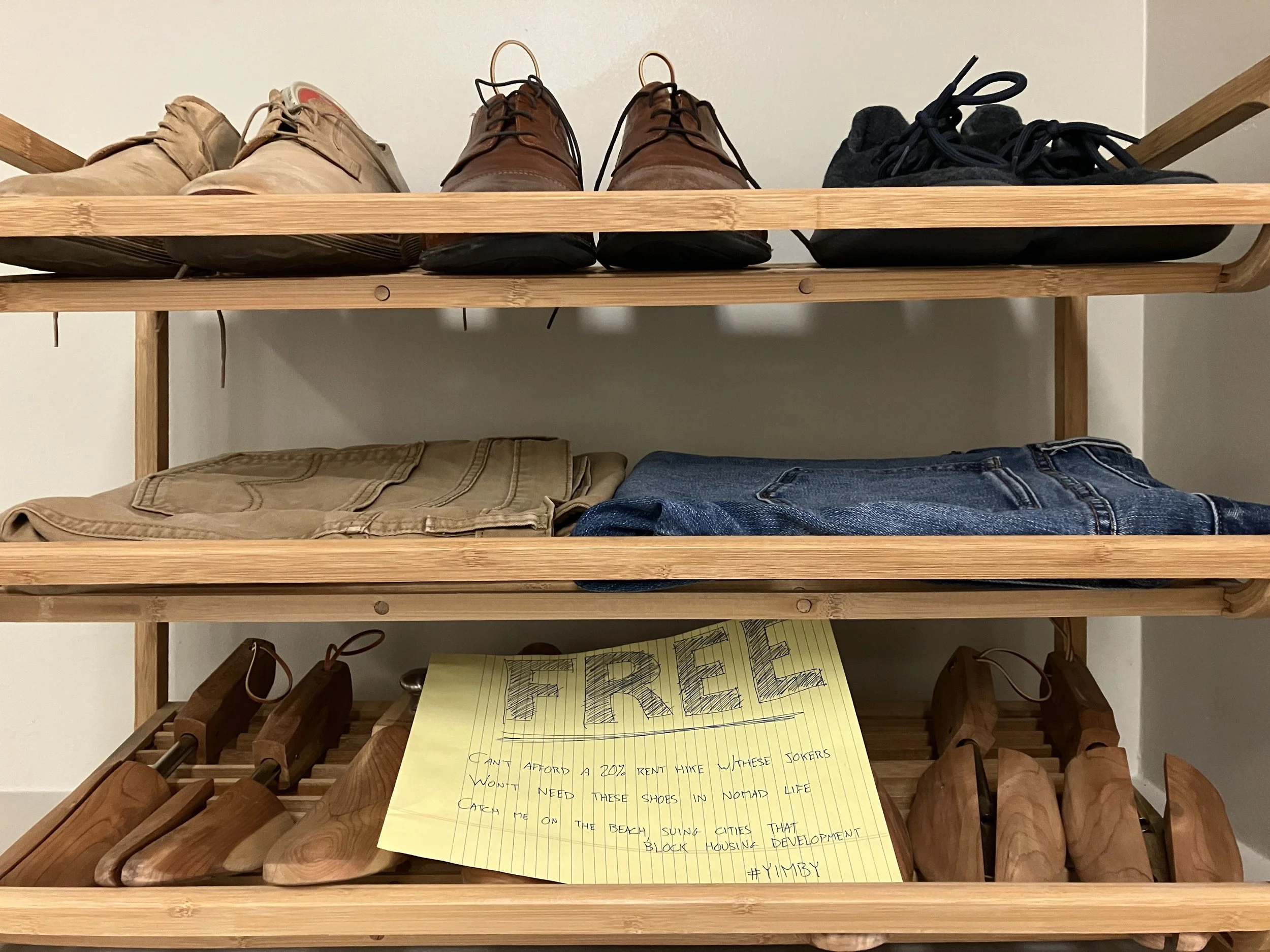
Can't have a shoe rack when your home is a Miata.

Can’t have a shoe rack when your home is a Miata

Something weird has happened in the housing market: short-term housing has become cheaper than long-term housing. All over the country, there are spare bedrooms and backyard sheds with monthly discounts on Airbnb. That’s how I’ve been living since May. I’ve saved thousands, even up and down coastal California, compared to what my former studio apartment in sonoran Arizona would have cost me. The ADU I just rented in El Paso was only $925.

Yes, the freedom is nice. I do not miss having a landlord, and you’re kidding if you think I’m taking a 30-year mortgage at these prices. But there is a day every month when I can’t leave my car. And there are entire months, depending on the layout and my hosts and their pets, when I can’t cook or use the bathroom at night. There’s a lot to be said for having a home.

California started this crisis, and it needs to fix it. That’s what motivated me to come work here. After a year in and out of the state, though, I can’t help but feel like Californians forget there are 49 other states affected by its housing crisis too. Being less equal than anywhere west of Louisiana, the state codifies an eleven-syllable term for equality and calls itself a leader. Housing elements are a lot of labor and bickering and bureaucracy for a half-million pages that aren’t real-world housing, and I can’t say what good they are unless they just legalize housing. (Thank you, Alameda.)

I’m done posting every week for a while. California law is too much. There will still be a housing shortage after Bay Area housing elements come due next week, I’m busy tracking where the builder's remedy might apply, and I’ve got lawsuits to prepare. You’ll hear about them next time I post.