Certifying for the Wrong Reasons

San Anselmo’s draft housing element (p.133) would “allow[] missing middle housing types in all residential districts.” 

San Anselmo’s draft housing element was not certified by HCD.

Sausalito’s housing element wasn’t yet written when the city voted to adopt it. (They wanted to beat a deadline.) State law requires the city to upzone, but instead, the city will be asking its voters to upzone.

Sausalito’s housing element was certified by HCD.

Now comes Los Altos Hills, bragging that HCD’s recent certification “protects us from [housing] under [the] Builder Remedy.” Like Sausalito, the town council didn’t vote on its final housing element, which claims (p.6) that “non-substantive changes” made after the vote by staff made the difference in certification.

It isn’t hard to tell when a city wants to welcome new neighbors. San Anselmo does, and an administrative agency sent them back to the drawing board. Sausalito and Los Altos Hills don’t, and they’ve been certified.

Housing matters more than housing elements. Too bad the law has its priorities reversed.

One Year Displaced

A year ago today, I woke up in a hotel in California. I’d driven there the night before after packing what remained of my belongings into my Miata and saying goodbye to my friends in Phoenix, where I’d lived for seven years. I left because an influx of priced-out Californians priced me out of Arizona. I no longer had a home.

Of course, I could have paid (28%) more to keep my apartment in Phoenix, and I afforded temporary homes in nice places anyway. Still, housing insecurity has become a common experience, especially (though not exclusively) for younger generations. And people need housing too much for things to stay this way forever.

Save Money, See Places

People have lives to live while construction can’t happen fast enough. When housing becomes unaffordable, people double up. I’m not the only one doing this, and I suspect it’ll become more common as housing prices remain high. Jane Jacobs noted this phenomenon in the 1920s and ‘30s in Dark Age Ahead (2004).

Throughout 2022 and into this spring, I hopscotched through a series of one-month rentals on Airbnb. The short-term rental giant’s rooms have undercut the housing market in much of the West. I lived in Eureka, Seattle, Lake Tahoe, Santa Barbara, San Luis Obispo, San Francisco, Los Angeles, Tucson, El Paso, Berkeley, and Sebastopol—all transiently cheaper than my former studio apartment in Phoenix. 

Now I live in Santa Cruz, improbably, with a partner who rents a basement from a couple who I’d guess have paid off their mortgage. There’s no way we could afford a market-rate home here, despite two well-paying jobs. The restaurants close at 8pm because so few workers can afford this city, and it’s rare to see children playing in silent neighborhoods of second homes. The weather is probably too nice for Santa Cruz to shrink forever, but it will take a long time for it to welcome working families again. People are likely to orchestrate micro solutions, as my newfound household has, before the government or the building industry can.

Horribly, most cities outside California restrict people from taking on housemates. That’s actually how the U.S. Supreme Court justifies single-family zoning. See Vill. of Belle Terre v. Boraas, 416 U.S. 1 (1974); but see City of Santa Barbara v. Adamson, 27 Cal.3d 123 (1980). YIMBY Law isn’t litigating this issue, yet. With that, let’s check in on our housing-element cases.

Housing-Element Litigation Update

Currently, we’re litigating against Burlingame, Cupertino, Fairfax, Palo Alto, and Sausalito on their housing elements. Of these, we have moved for judgment against Palo Alto and Cupertino. Different aspects of all five cases are still developing in court. We’ll share results as they come.

To our dismay, HCD certified Sausalito’s housing element. HCD’s certification has no bearing on our primary CEQA claim, which offers its own path to the builder’s remedy should we prevail. Certification simply means we’re litigating “against the standard” on our secondary housing-element claim. But that’s often what public-interest litigation is about; public-interest litigants prevailed against the standard last month. We remain unamused by the city’s shenanigans, and we intend to see this case through.

And Now for Something Completely a Little Bit Different

While we’re litigating housing in California state court, there’s an entire federal judiciary constantly wrestling with the whole universe of federal law. Part of that universe is the First Amendment.

In a case now before the Ninth Circuit, the state board of land surveyors has taken the position that drawing lines on satellite maps requires a land-surveying license. But of course, housing activists in California do that all the time. No one should need a license to comment on a housing element’s site inventory.

We’re pleased to share that the UCLA School of Law’s First Amendment Clinic has filed an amicus brief for Yes In My Back Yard in support of the case against the land-surveying board. Thank you to UCLA Law students Ian Levy, Katarina Rusinas, Asim Zaidi, and their Prof. Eugene Volokh, for authoring the brief. Here it is:

YIMBY Amicus in Crownholm v. Moore

Clovis Caper Creates Caselaw

The Fifth District Court of Appeal has published a fresh, citeable precedent on the housing-element law. Here are our thoughts.

Beyond Fonseca

First off, congratulations to Central California Legal Services and the Public Interest Law Project for their well-litigated victory. Their win, Martinez v. City of Clovis, is the most comprehensive housing-element case since Fonseca v. City of Gilroy (2007) 148 Cal.App.4th 1174. Fonseca had interpreted the housing-element law as codified in 2002. It was already outdated in 2007, and the statute has been revised much more since then. So we’re glad to have an interpretation of the housing-element law as codified in 2019. It’s challenging to litigate on thin precedent, and we’re grateful to the Martinez team for setting a new one.

DALL·E rendition of Clovis as Eagleton

Clovis, the Eagleton to Fresno’s Pawnee, had a housing element. (The San Joaquin Valley’s housing elements aren’t due for an update until the end of this year.) Clovis’s housing element was about what you’d expect from an Eagleton. Clovis wore HCD down and got its housing element certified, but that didn’t deter housing advocates from suing. The housing advocates won, and Clovis appealed.

The court of appeals agreed: Clovis’s housing element wasn’t compliant. That the court disagreed with HCD’s certification shouldn’t be a surprise, since substantial compliance is a question of law. It depends on what the statute requires. 

In this case, the housing-element statute requires … that a subset of a subset of sites, designated in a housing element’s inventory of land, must be zoned at both of two parallel minimum densities. Got it? 

This is where we repeat that the 40,000-word housing-element statute is too complicated. We’ve read and could explain Martinez’s settling of the interaction between overlay zoning and minimum densities—we may have to, in our own lawsuits—but we think such details distract from the bigger picture. The rent is too damn high! Zoning created this crisis. Overlay zoning isn’t going to save us from zoning.

Toward Equality

Martinez is, more notably, the first appellate case to apply California’s 2018 mandate to “affirmatively further fair housing” (aka “AFFH”). Much ink has been spilled elsewhere on AFFH, and it’s nice to see some ink dry at last in the Official California Appellate Reports.

The good news is that AFFH is judicially enforceable. It can be litigated under Section 1085 of the Code of Civil Procedure.

The huh? news is that we still don’t know what, exactly, AFFH means. The statute says it means “meaningful actions,” which means the legislature assumed someone else would decide what “meaningful” meant. In Martinez, the court holds that neglecting the parallel minimum-density mandates, in and of itself, violates AFFH. But so what? It already violates the housing-element law. Martinez also ruled that it might violate three older nondiscrimination statutes. So while Martinez says that AFFH requires something “more than” nondiscrimination, the court found no occasion to explain the difference.

This is not equal protection!

Our view is that AFFH is a long acronym for “equal protection,” and that equal protection means apartments should be legal wherever houses are. Why today’s courts don’t (yet) agree with us is a long story. We’re working on it.

The Chronicles of Californarnia

On π day, we predicted that at least ten cities would learn they’ve got more work to do on their housing elements. We were right about all ten (as of this afternoon, San Carlos, Walnut Creek, Colma, and Los Altos Hills hadn’t conspicuously posted their HCD rejection letters online).

It would be nice if HCD posted its review letters, too. But they’re busy, reviewing 539 often-thousand-page housing elements. Meanwhile, local governments are arguing with HCD in the press. That’s where we’re at, so let’s examine some of the confusion about who’s where with housing elements.

Trying the Hitch in the Poor Code

At 40,000 words, the housing-element law is longer than The Lion, the Witch and the Wardrobe. That’s a problem. A novel-length statute had better tell a novel-quality story about how local governments should plan for housing. The statute we have is a sprawling mess of word pollution.

DALL·E rendition of “housing aslan”

Housing elements waste everyone’s time tilting at windmills. The legislature could repeal the zoning enabling act, or at least set a minimum maximum density for urban regions; instead it has chosen to fight local bureaucracy with state bureaucracy. Site inventories must pretend to predict the future, when the future follows no plan. Housing advocates are relegated to playing Sancho Panza, counseling HCD’s regulators-errant to scrutinize countless sites in the hope that their local ínsulas might be ordered to legalize housing. In 54 years, this system hasn’t solved the housing crisis, and it’s reasonable to ask if it ever will.

If YOU’re Explaining, YOU’re Losing

It’s troubling that the system generates so many questions about procedure. Good procedures go largely unnoticed. Bad procedures steal attention from the substance of the law.

Since our last post, HCD published a compliance memo clarifying the procedures for adopting a housing element. (Gov. Code § 65585.) HCD reads the statute like we do. Local governments must submit at least one draft housing element for a 90-day review before they can adopt, and whichever housing element they adopt should have been reviewed by HCD. Housing elements should not be revised willy-nilly between review and adoption.

Section 65585 isn’t the only law on adopting a housing element. As we wrote in our last post, there’s a whole article of planning law governing general-plan revisions, which all housing elements are. Among other requirements, there’s supposed to be a “written recommendation” from the planning commission to the city council or board of supervisors (§ 65354), “at least one public hearing” (§ 65355), and a four-amendment annual limit (§ 65358, subd. (b)). 

As local governments scramble to block the builder’s remedy for fear of by-right affordable housing, HCD seems to be letting these more general requirements slide. To cite one example, HCD certified Oakland based on “modifications” that the Oakland City Council never voted to adopt. What happened was that Oakland “authorize[d] staff to make non-substantive changes” on p.6 of its adopting resolution (filed “January 32”). But any changes required to “achieve certification,” as Oakland intends, are necessarily substantive. To our knowledge, there wasn’t a hearing on these revisions. 

Berkeley, Glendale, La Habra, Santa Rosa, and surely others have had staff modify their adopted housing elements, too. That’s probably okay for correcting a typo. It isn’t legal for bringing a housing element into compliance. But we’re deep into arguments about procedure here—traditionally the province of nimby litigants trying to block change. We need change, and for that, we’re going to need a better system.

What’s Stopping the Priced-Out Majority?

According to the Terner Center, the majority of California renters are overpaying for housing: the housing “market,” thoroughly rigged by minimum lot-size requirements, no longer provides enough supply for the middle class to spend less than a third of its income on rent. One would expect a cost-burdened majority to have some political sway, and that does seem to be true in Sacramento—it’s also true in red-state capitals such as Billings and Tallahassee. So what’s the holdup here?

California’s political paralysis has much to do with 39 million people being divided, unevenly, into 539 local governments. Few of these are true cities, the time-tested kind who coalesce over centuries. Out of 482 incorporated cities—58 local governments are counties, and San Francisco is both a city and a county—370 were incorporated after 1900, and 199 were incorporated after World War II. Most are better described as municipal corporations, for they behave more like corporations than like real cities.

The real function of the housing-element law is to delegate the need for political courage from the state to these 539 municipal corporations. The problem is that corporations are cowardly. Being corporations, they’re more attuned to looking for loopholes.


Sausalito ain’t no Santorini

Take Sausalito, which voted on January 30 to adopt a housing element that it had only published the afternoon before. A traditional city, enacting any meaningful policy, would never. Sausalito’s rush to adopt a hastily rewritten housing element, in open fear of the builder’s remedy, ran roughshod over the spirit of Section 65585’s public-comment requirements. So why didn’t we sue them for curtailing public comment? Well … the literal requirement is to post any “subsequent” draft housing element “at least seven days before submitting” to HCD. (Gov. Code § 65585, subd. (b)(3) [italics added].) Sausalito found a loophole: it voted to adopt after one-day public comment, but complied with the letter of the law by waiting weeks to submit. 

If you’re going to have a 40,000-word statute, you’re going to have loopholes. Oh well. We sued Sausalito for other shenanigans.

Coda: Surf City Silliness

We aren’t wasting time on that federal lawsuit alleging “fraud” against the governor for saying there’s a housing crisis. There is a housing crisis. But here’s a nice OC Register interview on why that lawsuit is a waste of time.

There's No Such Thing as "Self-Certification"

By the end of the month, HCD will have issued findings on some two dozen cities’ housing elements. Administrative procedure is confusing, and housing elements confuse people. Confusing procedures invite shenanigans. We hear a lot of questions about “self-certification” especially, and the short answer is that it’s a legal way for cities to dare litigation. The long answer is the subject of today’s post.

So–before (guessing!) Goleta, Moraga, San Carlos, Walnut Creek, Colma, San Mateo, Clayton, Danville, Lafayette, and Los Altos Hills learn they’ve got more work to do—let’s look at the statutory roadmap to substantial compliance: what substantial compliance is, and the administrative procedures for achieving it.

“Substantial Compliance” Is a Question of Law

If you’ve read our Sausalito petition,you know that “[s]ubstantial compliance is question of law.” (Pet., ¶ 195.) There are no magic words in law, but the term “question of law” carries legal significance. It refers to the kind of question that only a court can decide. This matters because HCD is not a court. HCD is an administrative agency, and even though it has the duty to “determine whether [a] draft … substantially complies” with the housing-element law (Gov. Code § 65585, subd. d)), HCD’s “written findings” (ibid.) are not binding on courts.

For emphasis: only a court can ultimately decide whether a housing element “substantially complies” with state law. (Fonseca v. City of Gilroy (2007) 148 Cal.App.4th 1174, 1191.) HCD’s determinations are just that: determinations. The courts are free to disagree with HCD, and when they do, their judgments (mostly) control.

  • As with most legal questions, and too often in California, it’s complicated and it depends. There are bits and pieces of the housing-element law, such as the timelines for rezoning, that depend more on HCD’s compliance determinations than those of the courts. (See Gov. Code § 65583, subd. (c)(1)(A) [it’s complicated].) For builder’s-remedy purposes, though, the courts’ compliance findings matter more than HCD’s.

Thing is, most housing elements never get litigated. Few developers want to litigate, and there aren’t (yet) enough YIMBY lawyers to challenge all the bad housing elements. (If you’re a hotshot litigator who’s dissatisfied with modern land-use law, please consider joining us.) For the majority of housing elements, where no one seeks a court judgment, HCD’s compliance findings are simply the best available proxy for “substantial compliance.”

In court, “ ‘substantial compliance’ … means actual compliance in respect to … every reasonable objective of the [housing-element] statute.” (Fonseca, above, at p.1185; see also Camp v. Bd. of Supervisors (1981) 123 Cal.App.3d 334, 348 [a pamphlet doesn’t cut it].) Yes, the “actual” is italicized in the court opinions.

In other words, “substantial compliance” all depends on what the housing-element statute requires. The stronger requirements, like those for constraint removal and about nonvacant lower-income sites, put the burden of proof on the government. (E.g., Gov. Code §§ 65583, subd. (c)(3); 65583.2, subd. (g)(2); 65587, subd. (d).) Weak requirements, such as the requirement to “[a]ffirmatively further[] fair housing,” delegate to cities the task of deciding which actions have “meaning[].” (See Gov. Code § 8899.50, subds. (a)(1), (d).) That’s too bad about the weak requirements, but the strong requirements do debunk the myth that “substantial compliance” means “close enough” or “come on, they tried.” No! Every reasonable objective of Section 65583.2—the site-inventory statute—is a real requirement. (See Fonseca, at pp.1196–97.) And a court can (almost) always enforce those requirements, no matter HCD’s findings.

  • Don’t get us started on California’s statutes of limitations.

Don’t Confuse “Certification” with “Compliance”

Like we said, confusing procedures invite shenanigans. We’ve heard a lot of chatter about “self-certification,” i.e., the adoption of uncertified housing elements. As we’ve written elsewhere, certification isn’t at all equivalent to compliance.

A housing element is an element of a general plan. (Gov. Code § 65302, subd. (c).) There are general rules for adopting general-plan revisions; we won’t get into those here. What we’re talking about today are the special rules for revising a housing element. Those rules are in Section 65585 of the Government Code.

The key characteristic of the housing-element revision statute is that it’s an administrative procedure. Section 65585 mandates administrative review of every housing element. HCD is the reviewing agency, and every local government is required to either get certified by HCD or else explain why the local government believes HCD’s findings are wrong. We’re confident the statute requires at least that much.

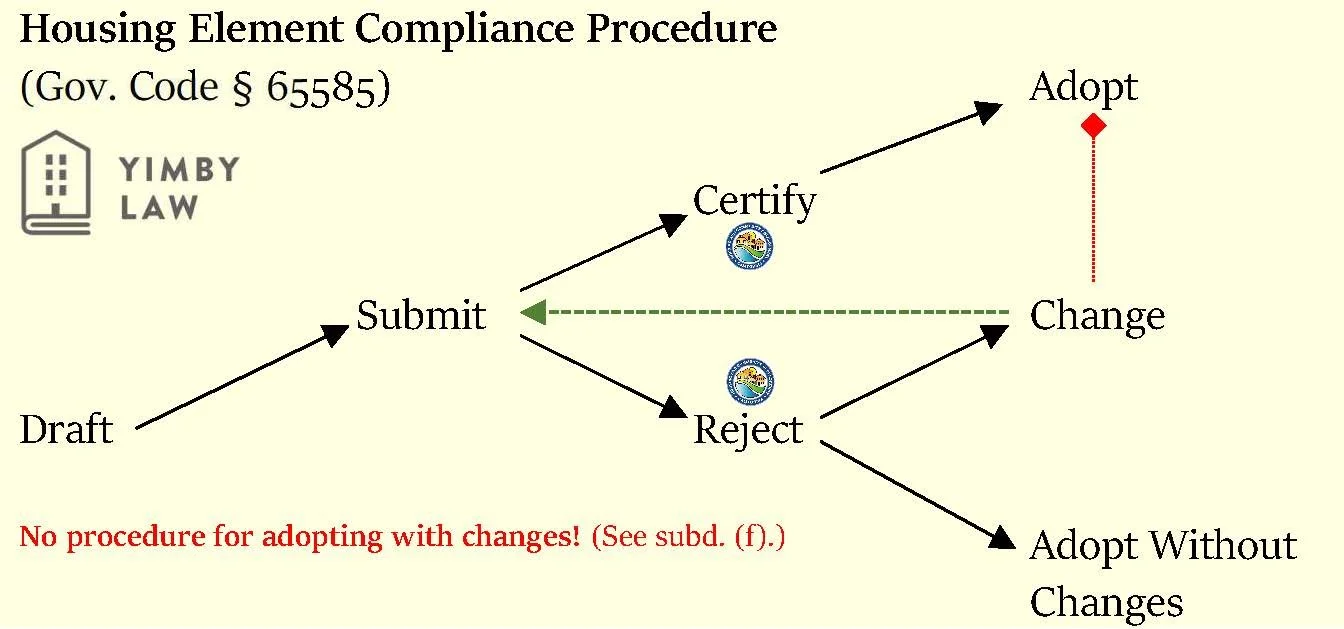
We read Section 65585 to require at least four distinct actions on the road to compliance: local governments must draft, submit, certify, and adopt. To “draft” is to post for public comment. (Subd. (b)(1).) To “submit” is to seek HCD review. (Ibid.) To “certify”—a term that isn’t in the statute, just fairly implied—is to provide “written findings” that a draft “substantially complies” with the housing-element law. (See subds. (d), (f)(2).) And to “adopt” is to enact in any manner provided by law. (Subds. (b)(1), (e), (f)(2), (g); see id. §§ 65350 et seq.) These are necessary, but not sufficient, procedural conditions for compliance: substantial compliance is a question of law!

Most local governments get the first two procedures right. Things get dicey at and after the certification stage, where the intuitive ideal of “law” breaks down under a 40,000-word statute. We’ll put that problem aside for this paragraph. Obviously, HCD can certify a housing element. This creates a “rebuttable presumption” that the housing element is compliant. (Gov. Code § 65589.3.) Surprisingly to some, local governments can also adopt their housing elements “despite” HCD findings of noncompliance. (Id. § 65585, subd. (f)(2).) There’s just no presumption of validity without HCD certification. (Id. § 65589.3.)

The procedures for adopting an uncertified housing element are sadly too squishy. The governing provision is subdivision (f), and there’s a good argument that a local government, with HCD’s rejection in hand, may only take “one of the following actions”: either “[c]hange the draft … to substantially comply,” or “[a]dopt the draft … without changes.” (Gov. Code § 65585, subd. (f).) In practice, too many local governments to count have adopted their uncertified housing elements with changes. And we simply can’t sue them all.

We think the natural reading of Section 65585 provides for uncertified local governments to “change” their rejected housing elements by resubmitting for HCD certification before adopting. (Gov. Code  § 65585, subd. (f)(1).) The statute clearly authorizes that approach. And we respect that it is procedurally (though not substantially) compliant to adopt a rejected housing element “without changes.” (Id., subd. (f)(2).) But we cannot see how a city or county could argue that the Legislature intended them to make hasty changes in a dash to “self-certify” against the builder’s remedy. The closest viable approach to this argument can only depend on the statute being a word salad.

With all that being said, housing-element adoption shenanigans don’t yet appear to have been addressed by any appellate court. This can’t be lost on the cities that fear by-right affordable housing. As a strategic matter, we only have the resources to sue cities that flunk a clear procedure or adopt an especially bad housing element. So until the law clears up, we need you to demand your city certify with HCD before adopting its housing element.

We’ll cover public comment, and the metastasizing problem of post-adoption staff revisions, in our next post.