
"We're from California."

California infuriates me sometimes. I’ve returned to Berkeley after two months in Tucson and El Paso, and I have to say: it was nice being able to talk about housing without talking about housing elements. “RHNA” isn’t a word in Arizona. But the interior Southwest has a housing crisis too, and it’s connected to California’s.

I know this from experience.

For seven years, California was an expensive place I could sort of afford on vacation. I had a job I liked in Arizona, where I could rent a minimally maintained two-bedroom for $815 (2015) and, after a couple raises, a nicely renovated two-bedroom for $1250 (2017). Rents were stable enough until the pandemic. 

“We’re from California.” Confined to my uptown Phoenix apartment in the summer of 2020, it was impossible not to overhear the real-estate agents and the moving trucks. My then-girlfriend’s S.F.-based coworkers all relocated to Phoenix. My landlord suddenly wanted, and surely found an ex-Californian to pay, $1450. Saving was trendy then, so back down the housing ladder I went to a crappy corporate studio apartment for $1280 (2021). The building was full of ex-Californians. When it was time to renew, Weidner Apartment Homes tried gouging me for $1640 (2022). But the building, whose elevator had been broken for two months, hadn’t gotten 28% better. And there wasn’t a smaller unit for me to downsize to, so I told Weidner I would get lost. I’ll never forget commiserating with another soon-to-be-ex-Phoenician, similarly determined not to let Weidner rip him off, carrying his own furniture down the stairwell the day I moved out.
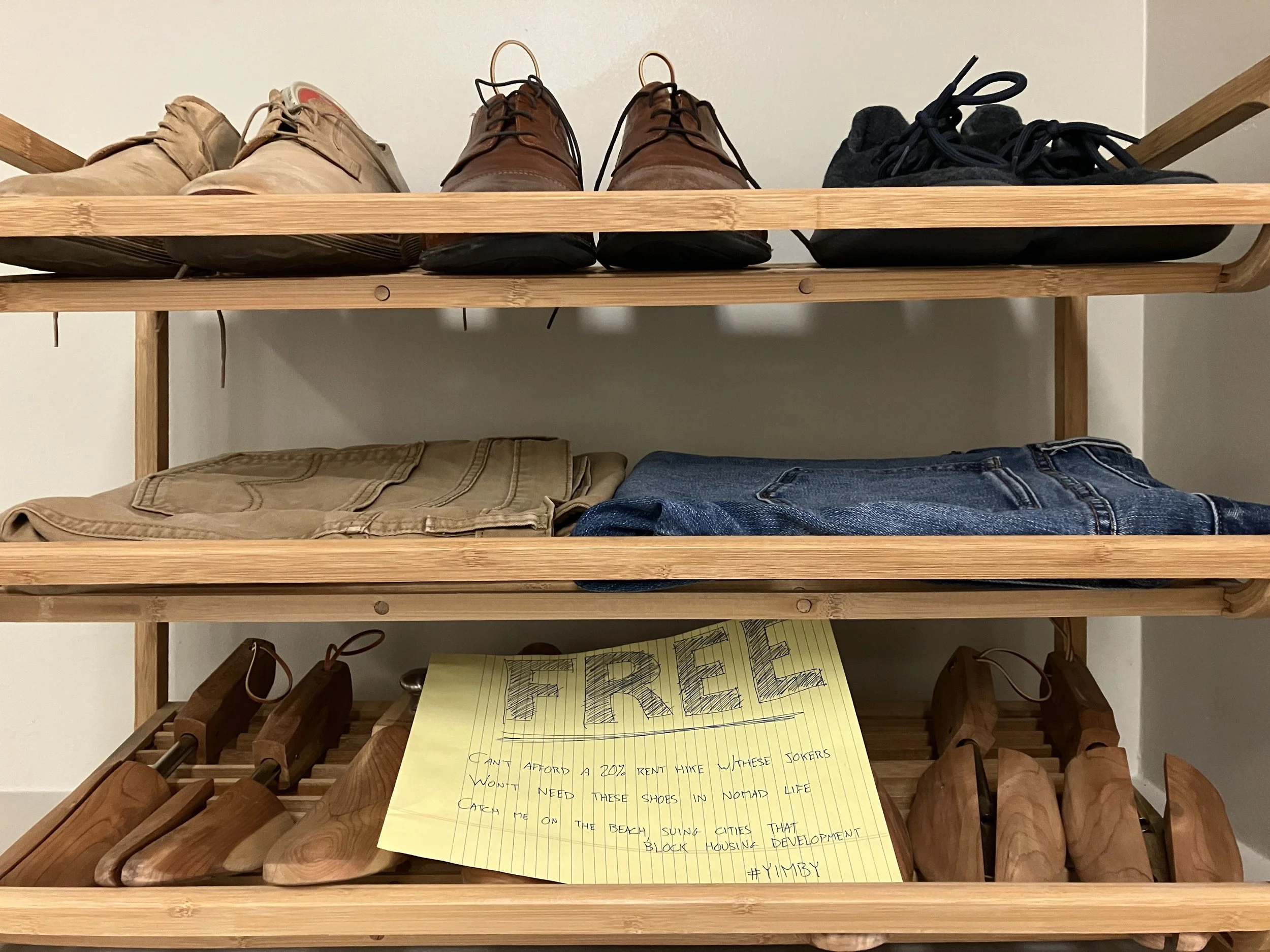
Can't have a shoe rack when your home is a Miata.

Can’t have a shoe rack when your home is a Miata

Something weird has happened in the housing market: short-term housing has become cheaper than long-term housing. All over the country, there are spare bedrooms and backyard sheds with monthly discounts on Airbnb. That’s how I’ve been living since May. I’ve saved thousands, even up and down coastal California, compared to what my former studio apartment in sonoran Arizona would have cost me. The ADU I just rented in El Paso was only $925.

Yes, the freedom is nice. I do not miss having a landlord, and you’re kidding if you think I’m taking a 30-year mortgage at these prices. But there is a day every month when I can’t leave my car. And there are entire months, depending on the layout and my hosts and their pets, when I can’t cook or use the bathroom at night. There’s a lot to be said for having a home.

California started this crisis, and it needs to fix it. That’s what motivated me to come work here. After a year in and out of the state, though, I can’t help but feel like Californians forget there are 49 other states affected by its housing crisis too. Being less equal than anywhere west of Louisiana, the state codifies an eleven-syllable term for equality and calls itself a leader. Housing elements are a lot of labor and bickering and bureaucracy for a half-million pages that aren’t real-world housing, and I can’t say what good they are unless they just legalize housing. (Thank you, Alameda.)

I’m done posting every week for a while. California law is too much. There will still be a housing shortage after Bay Area housing elements come due next week, I’m busy tracking where the builder's remedy might apply, and I’ve got lawsuits to prepare. You’ll hear about them next time I post.


Housing Element League Table

Happy New Year. The statutory deadline for Bay Area (and Santa Barbara County) jurisdictions to adopt a compliant housing element is January 31 (February 15). Most of them won’t.

There’s an emoji legend and some words at the end. But first, here’s what you’re looking for:

Alameda County

Contra Costa County

  • Contra Costa County: first draft not yet submitted to HCD 🏘️

  • Walnut Creek: rejected 12/5 ("many"); PC to recommend adoption 1/12; CC to adopt 1/17 😏

  • San Ramon: rejected 10/18 ("many"); revised draft submitted 12/29

  • Concord: rejected 11/14 ("many"); CC to consider 1/10; adoption plan unclear

  • Richmond: first draft submitted 12/9 (+90d = 3/9); PC recommended adoption 1/5 🤡

  • Antioch: rejected 9/29 ("many"); PC recommended adoption 1/4; adoption date TBA

  • Danville: rejected 11/10 ("many"); PC recommended adoption 12/13; TC to adopt 1/17 😏

  • Lafayette: rejected 9/29 ("many"); PC recommended adoption 1/3; adoption date TBA

  • Pittsburg: 🤡

  • Pleasant Hill: first draft submitted 12/27 🏘️

  • Brentwood: first draft submitted 10/17

  • El Cerrito: rejected 12/12 (unk.); adoption date TBA

  • Orinda: rejected 8/12 ("many"); revised draft submitted 11/16; revised revised draft published 1/5; adoption date TBA

  • Martinez: 🤡

  • Moraga: rejected 11/10 ("many"); PC to recommend adoption 1/10 😏

  • Oakley: rejected 11/29 (unk.); adoption date TBA

  • Hercules: rejected (unk.); revised draft submitted 1/5; adoption date TBA

  • San Pablo: rejected 12/27 (unk.); adoption date TBA

  • Clayton: rejected 10/12 ("many"); PC recommended adoption 12/13; CC to adopt 1/17 😏

  • Pinole: first draft submitted 12/2; CC to adopt in Apr./May 🏘️

Marin County

Napa County

San Francisco

  • San Francisco: PC recommended adoption 12/15; BOS to adopt in January

San Mateo County

Santa Barbara County (deadline = 2/15)

Santa Clara County

Solano County

Sonoma County

Emoji legend:

  • 🥳 = adopted and in compliance

  • 😉 = doing fine

  • 😏 = adopting with problems

  • 😱 = is HCD really gonna certify this?

  • 🏘️ = can’t, or doesn’t plan to, adopt before the statutory deadline

  • 🤡 = hasn’t published a draft, or is violating statutory procedure

In its review letters, HCD distinguishes between draft housing elements that address “many” vs. “most” statutory requirements. A “many” letter means the draft needs substantial improvement. A “most” letter means the draft is close to substantial compliance. 

Most of the time, we agree with HCD. But substantial compliance is a question of law. That’s how we can sue Redondo Beach, despite HCD’s certification. We think HCD got Redondo Beach’s certification wrong.

Your seasonally depressed correspondent will have more thoughts next week.


Busy Week

Last week I took a bye; this week I’ll show you why.

What Does It Mean to Be “Prohousing”?

Though our main mission is suing cities that block housing, we think the future is bright for cities that embrace it. One lesser-noticed component of housing-element law is the prohousing designation program, in which HCD has statutory authority to set the criteria by which cities are given bonus points for certain grant programs. As of December 15, 2022, the cities of Citrus Heights, Fontana, Oakland, Roseville, Sacramento, San Diego, and West Sacramento have been awarded this honor.

Anyone priced out today can tell you we need dramatic change to fix the housing crisis. HCD is considering changes to the prohousing designation program, and we think it’s a great opportunity to entice prohousing cities to lead the way. See our letter below.

 An “Alternative to Litigation” for the Builder’s Remedy

As we’ve written, dozens of Bay Area cities will be subject to the builder’s remedy starting in February. Last week, YIMBY Law worked with Californians for Homeownership and the California Housing Defense Fund (until recently CaRLA, of CaRLA v. San Mateo fame) to send demand letters out to these cities.

One way not to get sued is to agree that you’re subject to the law. Read our letter to Palo Alto—we sent the same letter everywhere—below.

Huntington Beach, You Can’t Exempt Yourself From state law!

I’m finishing up this post as the City Council of Huntington Beach is authorizing its city attorney to get Big Mad about the builder’s remedy. 13,000 new homes is too much, they say, and they want the State to “prove” that there’s a housing shortage. (Hey, Huntington Beach: I got priced out of Phoenix because of coastal California’s housing shenanigans. Now I live in a succession of sheds and spare bedrooms and have to move every month, and I’m Big Mad too. Go ahead, I’ll wait. I’ll still be here when you’re ready to be sued.)

Anyway, Huntington Beach can’t just declare itself immune from the law. I’m tired of thinking about this, so here’s the letter I wrote. Enjoy:

Bye Week

I read a lot of housing-element caselaw over the weekend, for a soon-to-be-not-so-secret project. On my mind: “There is a dearth of case law construing the inventory requirement” for housing elements (Fonseca v. City of Gilroy (2007) 148 Cal.App.4th 1174, 1197), and there are still problems with enforcing that requirement. So I’m taking a bye week to research whether and how our secret project can do anything about those problems.

Homes for the Holidays

We’re closing in on the end of the year, i.e., giving season. You know what I’m asking next.

I am the only attorney on staff at YIMBY Law, and I need help. Please donate so we can build the legal team we need to help end the housing crisis.

Thank you, and we’ll return with a more substantial post next week.

What Good Is the Law If It Makes People Homeless?

I’m posting from the hip after relocating from Los Angeles to Phoenix to Tucson to Berkeley over the last week. Got to visit old friends and their new kids, but little time to write a blog post. Hashtag, nomad life. Buckle in.

property rights are for everyone

Last week, I wrote that property law should be intuitive. Let’s explore this theme a little further.

Many of us share an intuition that people should be free to do what they want, short of harming others. Outside the specific context of housing, I’m not interested in what’s “harm” and what’s not. Whatever “harm” is, most people don’t—shouldn’t—care about things that don’t cause it.

In legalese, there’s a fancy Latin phrase for this concept: “sic utere tuo ut alienum non laedas.” (E.g., Vill. of Euclid v. Ambler Realty Co. (1926) 272 U.S. 365, 387; Green v. Gen. Petrol. Corp. (1928) 205 Cal. 328, 335.) I don’t know Latin, and I don’t know what this literally means. But Lexis can identify 1,154 appellate cases that quote it, and I’d wager it’s in most property-law textbooks. In lay terms, it means you can do what you want, as long as you don’t harm others.

Legally, home is a place where the law especially presumes that you can do what you want, and don’t harm others. We all live somewhere. This is why American law confers special legal protections on the home. At common law, “burglary” was specifically defined as breaking and entering someone else’s home. The Fourth Amendment specifically prohibits unreasonable searches and seizures of people’s “houses.” The Internal Revenue Code provides many tax benefits to homeowners. “In our tradition, the State is not omnipresent in the home.” (Lawrence v. Texas (2003) 539 U.S. 558, 562.) Shelter is a human need, and it’s humane to protect people in their homes.

Please, tell me again how hard you worked to buy your home in the ‘80s.

We don’t have to have tent cities. We just tolerate the policies that cause them. Though we still honor the home in some legal contexts, zoning law treats it as a special privilege rather than an equal right. This is new: the government hasn’t always suppressed the supply of housing. Plenty of civilizations, including America, have managed to house substantially all of their citizens. There’s no inherent reason home prices should outpace median income, as they have over the last generation.

Zoning Isn’t God’s Will

I talk to a lot of housing activists, and a common theme I notice is acquiescence in zoning law. It’s the playing field today, but we don’t have to accept it. Over and over, I hear questions about whether it’s legal for cities to impose x constraint on y-sized parcels in z zoning districts. (Often, the questions necessitate more prepositional phrases and abstractions than that.) The questions I want to hear are about why it’s legal to prohibit home construction at all.

No one would accept the premise of modern zoning as applied to any other basic human need. If the government made people choose between buying a single-family home barrel of apples or no home apples at all, there would be riots. This is exactly what minimum lot-size regulations do. And yet we tolerate a rigged housing “market” that does cause mass homelessness, and would cause mass starvation if applied to the grocery market.

A legal regime that impedes homefulness, without a clear health-and-safety reason, is illegitimate. Neighbors aren’t nuisances. I just spent a month living down the street from Skid Row; don’t talk to me about “the blessings of quiet seclusion” unless you own a secluded ranch. (Contra Vill. of Belle Terre v. Boraas (1974) 416 U.S. 1, 9.) We’ve inherited a regime that privileges legacy homeowners to ban other people’s homes. This regime is immoral, and it’s our duty to dismantle it.