
An Introduction, a Housequake, and Zombie Easements

Welcome back to the YIMBY Law Journal! It’s been a while, so let’s catch up.

Who’s This?

I’m Keith, and I’ve been managing YIMBY Law’s work on the Campaign for Fair Housing Elements since April. I’ll be writing here on Tuesdays as often as I can. 

I’m a lawyer with experience in public-interest litigation. Before YIMBY Law, I worked for seven years at the nonprofit Institute for Justice, where I helped set a few precedents. IJ taught me that every great case tells a story. I’ve met so many people in my career, and heard too many stories about land-use bureaucracy making life hard. I came to YIMBY Law to help change that.

Bad laws change when good stories persist. My signature case at IJ was a challenge to Nashville’s home-business ban, where I represented a record producer and a hairstylist who wanted to work from home. Public comment was against us in 2016, but my clients and I stuck to our beliefs, and by early 2020 we’d built enough public support for a change.org petition to go viral. Then the pandemic hit, everyone had to work from home all of a sudden, and Nashville repealed the ban (sort of: the case is still ongoing). I’m confident nothing would have changed if my former clients hadn’t made their stories public so many years ago.

Housequake!

Let’s turn to a story about lots of new homes coming to the Bay Area soon.

California law requires every city to produce a document called a “housing element.” In simple terms, the state assigns every city a number of new homes to plan for, and a good housing element shows how the city will make those homes legal to build. Some cities write bad housing elements, and the state Department of Housing and Community Development (“HCD”) can disqualify them if they’re bad enough. One potential consequence for a disqualified housing element is called the “builder’s remedy.”

The builder’s remedy preempts all local zoning for certain affordable housing projects. This removes a huge barrier to home construction, which is why we’re so excited about it. But the builder’s remedy only applies in cities without HCD-certified housing elements, so it’s not available in most places, most of the time.

Every eight years, California cities have to update their housing elements. And with new ramped-up housing goals set by the state, cities that are clinging to old, exclusionary zoning rules are struggling to convince HCD that they can meet their fair share. Most Southern California cities missed their deadline, and Redondo Beach now stands to gain 2,290 new homes thanks to the builder’s remedy. In the Bay Area–specifically anywhere in Alameda, Contra Costa, Marin, Napa, San Francisco, San Mateo, Santa Clara, Solano, or Sonoma Counties–the deadline for new housing elements is January 31. This deadline is now close enough that we can predict dozens of Bay Area cities will miss it.

That means Bay Area homebuilders can expect cities without zoning on February 1. HCD recently confirmed this timing in a letter to East Bay for Everyone’s Kevin Burke. San Francisco is scrambling.

We’re calling for a housequake to make the most of this zoning jubilee. If you have a potential builder’s remedy project, let us know, and get ready to tell your zoning authorities to shut up already, damn.

Zombie Easements

Last week, we joined the California Renters’ Legal Advocacy and Education Fund on an amicus brief in support of a 450-home project in Riverside. The city has cleared the project, and is even counting on it in its housing element. But a neighboring grocery store got a judge to block the project, based on a 1979 easement over one corner of the project site.

Easements are a type of private property restriction. The easement in this case gives the grocery store “ingress and egress” rights over a small strip of road so that delivery trucks can drive across the project site and get to the back of the neighboring store. Grocery stores and apartment complexes work these things out all the time, and we don’t see that the project developer in Riverside is planning to block the store’s access. Instead, the grocery store persuaded the trial court that the easement prohibits any apartments anywhere on the site. The project developer has appealed.

We and CaRLA weighed in to remind the Court of Appeals that there’s a strong public interest in getting homes built, and that the trial court’s injunction blocking 450 homes harms the public interest. What’s more, caselaw warns against interpreting “nonexclusive” easements (which this easement is) to prohibit entire land uses (as the trial court’s injunction does). But that’s effectively what the trial court did in Riverside, and we hope it gets reversed so Riverside can gain 450 new neighbors.

Many easements are useful: they help reconcile private property with public infrastructure, among other things. But as the Riverside case shows, easements can also be turned into anti-housing zombies. That’s not what easements are supposed to do, and we’re watching this case so that California doesn’t suffer an outbreak of zombie easements.
In a world of madness, the sane strategy is to go insane

Most of the time, the stalled housing projects we encounter at YIMBY Law are pretty straightforward. The local law allows the housing and the state law requires the city to approve it, the city knows this, or, accepts it once we point it out, but the immediate neighbors refuse to believe it, or believe the law is unjust and ask the City Council to fight it. Through a combination of grassroots organizing and threatening letters, everyone gets on the same page and the housing is approved. 

Sometimes, however, we find ourselves beyond the looking glass, sinking into a well of madness, our minds bending into shapes known only to an evil, otherworldly geometry. And this is where we found ourselves contemplating Los Angeles’ reaction to Akhilesh Jha’s proposal to build 7 stories, 60 apartments, 60 parking spaces and one floor of retail at 5353 Del Moreno Drive in Los Angeles, California. 

The Los Angeles General Plan land use designation for 5353 Del Moreno Drive is “Limited Commercial”. Among other things, Limited Commercial allows apartment buildings with a density of up to 1 unit per 400 square feet of the lot. So, on AJ’s, 20,000 sq ft lot, the general plan allows an apartment building of up to 50 apartments. (20,000/400= 50) In addition, the state density bonus allows another 17 units, for a total of up to 67 apartments. 

The zoning code, however, only permits a single family house, and, incidentally, a chinchilla farm. 

AJ submitted an application to the LA planning department to build a 60 unit apartment building, as described above. The LA Planning Department replied saying that the proposed density of 1 unit per 400 sq. ft. at 5353 Del Moreno Drive is not consistent with the zoning (see Attachment 1.1), so if he wanted to move forward with his project, he would need a zone change. 

No problem, AJ replied, the Housing Accountability Act, Gov. Code, § 65589.5(f)(4) states that “a proposed housing development project is not inconsistent with the applicable zoning standards and criteria, and shall not require a rezoning, if the housing development project is consistent with the objective general plan standards and criteria but the zoning for the project site is inconsistent with the general plan.” (emphasis added) My project is clearly “consistent with the … general plan standards,” so I do not need a rezoning. 

Well, said the LA Planning Department, that sentence only applies if the “... zoning for the project site is inconsistent with the general plan,” and the zoning at 5353 Del Marino (single family) is consistent with the General Plan designation (limited commercial). 

Wonderful, said AJ, to hear that the zoning is consistent with the General Plan. Given that my project is consistent with the General Plan, and the zoning is consistent with the General Plan, it sounds like my project is consistent with the zoning, and we can proceed. 

No, not at all, said the LA Planning Department. Your project is not consistent with the zoning, although it is consistent with the General Plan, and the Zoning is consistent with the General Plan, but the Zoning is not consistent with your project. 

What?

AJ wisely called YIMBY Law. 

LA Planning’s argument is basically that because the zoning allows a subset of what is allowed in the general plan, then the general plan and zoning are not inconsistent. It’s a maddening idea of “consistency” but it explains this apparent contradiction. 

LA Planning should have kept reading paragraph (f)(4) because the sentence after the one AJ initially cited still supports AJ’s project. It says that where the zoning is consistent with the General Plan, “the local agency may require the proposed housing development project to comply with the objective standards and criteria of the zoning which is consistent with the general plan, however, the standards and criteria shall be applied to facilitate and accommodate development at the density allowed on the site by the general plan and proposed by the proposed housing development project.” (emphasis added)

Cities therefore have no way out. If they think that the zoning for a site is consistent with their General Plan, they can only enforce the aspects of the zoning that facilitate the density allowed on the site by the General Plan. And if the city claims the zoning is inconsistent, then a project sponsor can basically ignore the zoning, and only look to the standards and criteria in the General Plan. 

We will be helping AJ build his apartment building, and maybe also a chinchilla farm. If you see any other examples of cities trying to avoid their duties under state law, let us know!

Attachment 1: Communications Between Planning Department Staff and Applicant

On Fri, Aug 7, 2020, 4:04 PM Justin Bilow <justin.bilow@lacity.org> wrote:

Hi AJ,

This email follows up on and summarizes information discussed during our call from Friday July 10, 2019.  Below is a summary of zoning information related to your proposed project at 5353 Del Moreno Drive (“Project”); information related to your questions about the Project’s SB330 Preliminary Application for vesting under Government Code Section 65941.1 (“Preliminary Application”); and contact information to assist you with pursing your later application for a development project.

1. The Preliminary Application Is Incomplete

The Project’s Preliminary Application for vesting under Government Code Section 65941.1 is not considered submitted because the Preliminary Application contains inaccurate information regarding the use of Density Bonus, and therefore does not contain all of the information required. The Preliminary Application states that the Project will seek Density Bonus incentives and bonus units for 60 residential units.  However, the site’s RA-1 zoning does not support a Density Bonus development because the existing zoning authorizes a single one-family dwelling. Additional density for the project may be sought through a Zone Change (LAMC 12.32 F) or Vesting Zone Change (LAMC Section 12.32 Q).

The Department seeks accurate and complete Preliminary Application information from the applicant at this early stage in order to, among other things: (1) give project applicants an opportunity to secure the earliest possible Preliminary Application submittal date through an early opportunity to correct and accurately submit all of the information required; (2) facilitate a smooth and expeditious development project application process because incorrect or incomplete information can cause unexpected delays or loss of vesting, (3) facilitate an applicant’s ability to maintain vesting rights during the next short development project application timeline — i.e., the 90-day period under Government Code Section 65941.1(d)(2) to submit information needed for the subsequent complete development project application; (4) provide an accurate basis upon which the City is required to evaluate any potential project revisions under Government Code Section 65941.1(c); and (5) avoid delays by facilitating an early accurate understanding about what standards, rules, and entitlement procedures apply to the project based on the information required by Government Code Section 65941.1.

Your requested findings under California Government Code Section 65589.5(j)(1) are not applicable to the Preliminary Application, and are therefore not required to determine that the Preliminary Application is incomplete.  The findings at Government Code Section 65589.5(j)(1) apply to the later development project application which is supposed to be submitted to the Department of City Planning within 180 calendar days after you submit a Preliminary Application with all of the information required.  See Government Code Section 65914.1(d). The later development project application would request specific development approvals through procedures, hearings, and findings specified by the Los Angeles Municipal Code.

2. The Site Requires A Zone Change For The Proposed Project

The site is zoned RA-1, but the Project is proposed at C1.5-1 development standards with 60 residential units.  As a consequence, the proposed Project requires the site to seek a Zone Change or Vesting Zone Change.

The site requires a zone change because the General Plan’s applicable Community Plan, here the Canoga Park - Winnetka - Woodland Hills - West Hills Community Plan (“Community Plan”), states that the site’s zone is consistent with the "Limited Commercial" land use designation.  Consistency is supported by: a) the Community Plan map, b) text in the “Plan Consistency" section on page 20 of the Community Plan, and c) Footnote no. 9 on the Community Plan Land Use Map relating to "Corresponding Zones."  Footnote 9 states the following in pertinent part:

“Each Plan category permits all indicated corresponding zones as well as those zones referenced in the Los Angeles Municipal Code (LAMC) as permitted by such zones unless further restricted by adopted Specific Plans, specific conditions and/or limitations of project approval, plan footnotes or other Plan map or text notations.”

Footnote 9 explains that each land use category permits the less intensive zones referenced by the LAMC, in addition to the more intensive corresponding zones listed on the face of the Community Plan land use map. The site’s zone-plan consistency is further explained by the City's hierarchy of less to more intensive zones found in LAMC Section 12.04-A, and a review of LAMC Sections 12.07 (RA zone) through 12.13 (C1.5 zone)....

Best Regards,

On Tue, Aug 11, 2020 at 5:09 PM Sarah Molina-Pearson <sarah.molina-pearson@lacity.org> wrote:

Hi Akhilesh,

Yes, the zone and land use designation are consistent. As I mentioned to you yesterday, I would like to continue to explore options for your project to move forward. Please feel free to reach out to me in the next week or two. If I receive any new information before then, I will make sure to let you know.

YIMBY Law's Lawsuit against Simi Valley Proceeds to Trial

Update: The trial has been rescheduled and will now take place on May 4th at 8:30 am. Updates on how to tune in and live results can be found on our twitter page.

This week, on Thursday April 15th, Yimby Law’s Housing Accountability Act lawsuit against the city of Simi Valley will have its first real hearing. The case is important as it involves fundamental questions about the HAA and what types of projects it can be used to protect. The project in question in this case is a senior living community. On Thursday we will find out whether the judge sides with the city in their narrow view of projects included under the HAA’s purview or whether the judge will side with us in our broad, comprehensive, and common sense view of which types of projects are protected by the Act.

The project at the center of all of this is a senior living community proposed on the edge of a residential neighborhood dominated by single family homes in the city of Simi Valley. Located north of Los Angeles, Simi Valley is a medium sized city that has struggled to meet housing production goals, as have many in the region. The city has not met it’s 5th cycle RHNA goals for low and very low income housing units and it is too soon to know whether it will fare any better in the 6th cycle. Additionally, Simi Valley is an aging city with a growing senior population that needs specialized housing options. In fact, the city’s most recent general plan specifically calls for facilitating more construction of senior housing and care facilities.

With all of this in mind the proposed project seems like a perfect fit for Simi Valley. The proposed development at Cochrane and Welcome Court, just off highway 118, would include 68 assisted living units and 40 memory care units. The proposed size, density, and massing of the project all fall within the restrictions set by both the city’s zoning ordinance and general plan. The developer diligently worked with city planning staff for 16 months to ensure that the project didn’t just meet, but exceeded their expectations.

However, once the project reached public hearings in front of the Planning Commission it became obvious that there was significant opposition to the project from neighbors. The concerns cited were overwhelmingly issues of aesthetic preference and neighborhood character with no grounding in the zoning ordinance or general plan. The Planning Commission caved to public pressure and denied the conditional use permit necessary for the project to move forward. The developer appealed this decision and the same process and outcome repeated itself at the City Council, with neighbor opposition leading to City Council affirmation of the Planning Commission’s decision.

In the findings provided with the resolutions denying the conditional use permit both the Planning Commission and City Council relied entirely on subjective concerns over aesthetics and neighborhood character. None of these findings are sufficient to warrant a denial of a housing project under state law. An additional finding, predicated on the idea that the project would pose a danger in the case of a wildfire as residents would flee to the facility, is absurd enough that there is little need to elaborate on it. Suffice to say, these concerns do not constitute “a specific adverse impact upon the public health or safety” as state law requires for findings in the case of a denial of housing.

The crux of the city’s argument does not rely on the woefully inadequate findings made by the City Council and Planning Commission. Instead the city argues that the proposed project is not protected at all under the Housing Accountability Act because the proposed units do not contain kitchens and therefore cannot be considered “residential units.” The HAA does not define what it means by “residential units” exactly and there is some legitimate ambiguity here. However, the idea that the broad definition of residential use contained within the HAA somehow precludes senior assisted living units is ridiculous.

Additionally, definitions elsewhere in state code and within Simi Valley’s local code support our assertion that senior assisted living units count as residential for the purposes of the HAA. There is no reason to believe that this project should be treated differently from other housing projects simply because of a difference in amenities, linked to safety. Lastly, the HAA itself states that it should be construed broadly and “consistent with, and in promotion of, the statewide goal of a sufficient supply of decent housing to meet the needs of all Californians.” (Gov’t Code § 65589(d).)

We feel our case is very strong and we believe strongly in the principle behind it. Cities should not be able to wriggle out of their obligations under state law with opaque and incorrect interpretations of state law. Lots of effort and hard work has gone into formulating laws over the last decade to improve the legal environment for housing in California. If cities can ignore or bypass these laws all that effort goes to waste and cities can act with impunity. It is our job to enforce state law in cases like these to protect the legal gains we’ve made in the housing space and to ensure that further gains are possible.

Dorms, SROs and other types of group housing do count towards cities’ Regional Housing Needs Allocations

There seems to be significant confusion regarding how HCD treats separate living quarters that do not have a kitchen for the purpose of the Housing Element process and in particular, for the purpose of fulfilling the RHNA. This type of housing is also known as Single Room Occupancy, or SRO housing, group housing, dorms, assisted living and is also known by other names. 

All of these arrangements share common characteristics. The tenant rents a room that is intended for occupancy as a separate living quarters. Usually they have a lock on the door, for instance, indicating that their private space encompasses that room, but not the hall outside the room. The tenant may or may not have their own bathroom facilities and may or may not have access to a shared kitchen or cafeteria. Each tenant has their own lease with the owner of the building or the facility, and the tenant considers this unit to be their usual place of residence.

SROs do not include hotels or hospitals because the inhabitants of these institutions intend to stay a short time, and have a usual residence elsewhere. 

Housing Element law and the guidance materials of CA Department of Housing and Community Development confirm that separate living quarters that do not have a kitchen ARE counted as housing units for the purpose of the Housing Element and RHNA. 

The Government Code sections governing the Housing Elements process, Article 10.6. Housing Elements [65580 - 65589.11], don’t contain an explicit definition of “housing unit”, however, in sections 65583(c)(1) and 65583.2(c), both dealing with the sections of the housing element that demonstrate the city’s ability to accommodate its RHNA, the following language is used: 

“a variety of types of housing, including multifamily rental housing, factory-built housing, mobile homes, housing for agricultural employees, supportive housing, single-room occupancy units, emergency shelters, and transitional housing.”

This list includes “single-room occupancy units”, indicating that single room occupancy units are units for the purpose of fulfilling RHNA goals. 

HCD’s guidance on what constitutes a housing unit for the purpose of the RHNA references the Census definition of housing, and mostly concurs with the definition in state law:

Do Single-Resident Occupancy (SRO) units count toward RHNA progress? 

SRO units can be counted if the units are operated as separate living quarters, and occupied or will be occupied by persons who consider the unit their usual place of residence, rather than temporary motels. 

Can I count dorms in a college town? 

Dormitories, bunkhouses, and barracks cannot be counted as housing units, but student housing that is set up as separate living quarters per the census definition can be counted.

Can I count senior housing? 

Beds or quarters in an institution or hospital do not count, but separate living quarters per the census definition. For example, senior housing with individual units that would allow for eating and living separately for the broader community could count.

(Source: Department of Housing and Community Development Housing Element Annual Progress Report Frequently Asked Questions (FAQs)

HCD’s guidance on “Dormitories” causes some confusion. In context they seem to be describing a big room with multiple beds, in other words, a barrack. However, no US College houses students this way. Instead, college dorms are a type of SRO: a US College dorm is a building with a number of separate living quarters, with a shared kitchen or cafeteria. 

Dorms, retirement homes, residential hotels, sober living, long term drug rehab, board and care facilities, are all types of housing where tenants can have separate living quarters without a kitchen and usually also have access to a shared kitchen, in other words, SROs. These are also types of housing that California cities need more of. These are all long term living situations. Residents of this kind of housing can expect to spend at least one year and at most the rest of their lives living there. 

YIMBY Law looks forward to working with localities in their efforts to meet their RHNA and to craft and pass housing elements that are certified by HCD. We are also interested in promoting zoning for and constructing diverse types of housing, including separate living quarters without a kitchen as described here. Please get in touch with us if we can be of assistance.

For a google drive version of this post, click here. You can download a pdf version from the drive. Please feel free to email a pdf to a planner or decision maker in your local government, or ask us to by emailing sonja@yimbylaw.org

What kinds of emotional distress are public problems?

The practice of zoning today has become extravagant and baroque. Far beyond the already abhorrent goals of “protecting” higher income people from having to interact with residents of apartments, (see previous post) local governments also respond - at significant expense - to the anxieties and agonies of single family homeowners, for whom banning apartments is insufficient, when they become distressed by the prospect of single family homes that look like apartments. 

Culver City, for example, recently completed a nearly 3 year process of rezoning their single family neighborhoods. Fortunately, by the time they passed the zoning ordinance reducing the maximum allowed size of houses (FAR) and prohibiting more than one kitchen per unit, this kind of downzoning had become illegal, and YIMBY Law filed suit to stop it. The excerpts below are from a public records request we did as part of our lawsuit. You can view all of the records here

On Oct 17, 2019, at 10:52 AM,
Amy Levit wrote:

Could we maybe put a moratorium on new builds until the new codes can be put in place. Some of the new builds are so outrageous...take a look at 4301 Mentone Ave for example...almost 5,000 square feet...looks more like an apartment building than a home!

Thank you!
Amy Levit

Notes from a community meeting held on 09.18.2018:

[Resident] concerns included … Change of neighborhood character from single-family residential to multi-family residential when homes of similar style and materials (sometimes built by the same developer) are built to the maximum floor area ratio (FAR) and zoning envelope and are adjacent to one another.

From: Greg Cahill 
Date: Monday, May 25, 2020 at 3:16 PM

Dear City Council members:

... My wife and I and our two daughters moved here thirty years ago and now I fear the small town ambience we moved to Culver City to enjoy is being irretrievably eroded before our eyes.

From: Michael Monagan 
Thursday, April 18, 2019 7:10 PM

Hi William,

I’m Michael Monagan and I have lived on Fay Ave in the Arts District for 17 years. We have suffered and are suffering from overbuilt homes in our neighborhood.

Notes from a community meeting held on 09.18.2018: 

The continued construction of similar houses that maximize the FAR and “flipped” is upsetting for residents. “I live in fear that my neighbors are going to sell and a developer will come in and build a huge inappropriate house. The flippers are ruining the neighborhood.”

Local officials receive distressed pleas from all kinds of “suffering” and “fearful” residents. In addition, all of us suffer and are fearful at one time or another. The question is, what kinds of emotional distress are really public problems, and which are best solved privately? 

The answer to this question has changed over time, and also, in our time, depends on who is making the plea. Existing and historical land use patterns demonstrate unequivocally that when low income and non-white people express suffering and fear over nuisance land uses - even when those land uses are true nuisances, that cause asthma or release poison into the air or water - local governments ignore them. 

However, as in the Case of Culver city, when high income and white people express their land use related fears - even those land use fears that are totally subjective, and have absolutely no health related impacts - local governments mobilize significant staff time and resources to soothe their anxieties and accommodate their tastes. 

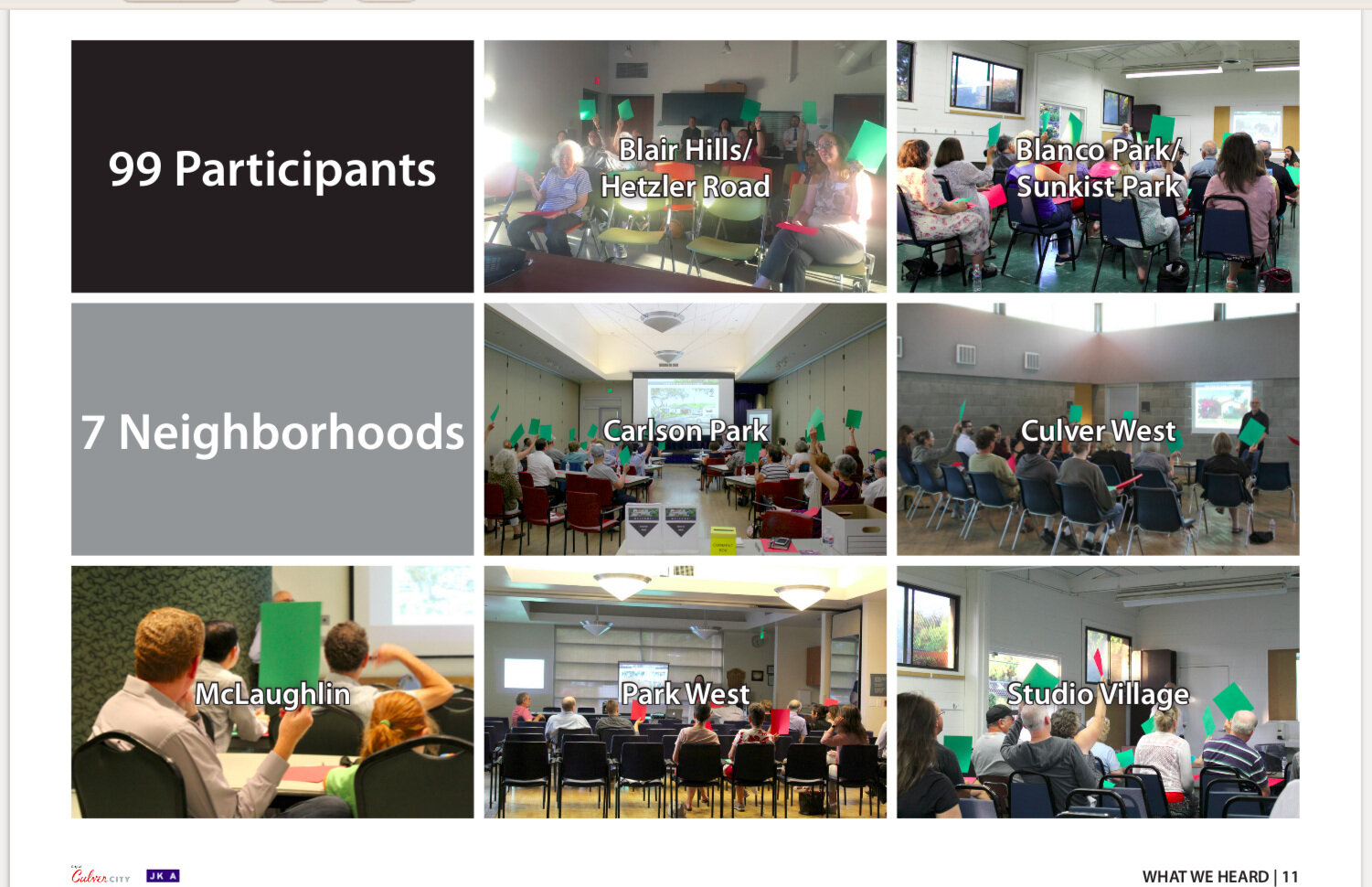
In 2017, Culver City hired John Kaliski Architects to helm a multi-year public process to develop new zoning standards to respond to the distress demonstrated by some Culver City homeowners. As part of this process, the city hosted ten meetings, each one 1.5 hours, where homeowners looked at photographs of houses, and indicated whether they thought the houses were pretty or ugly. Here is a sample description of one of the meetings:

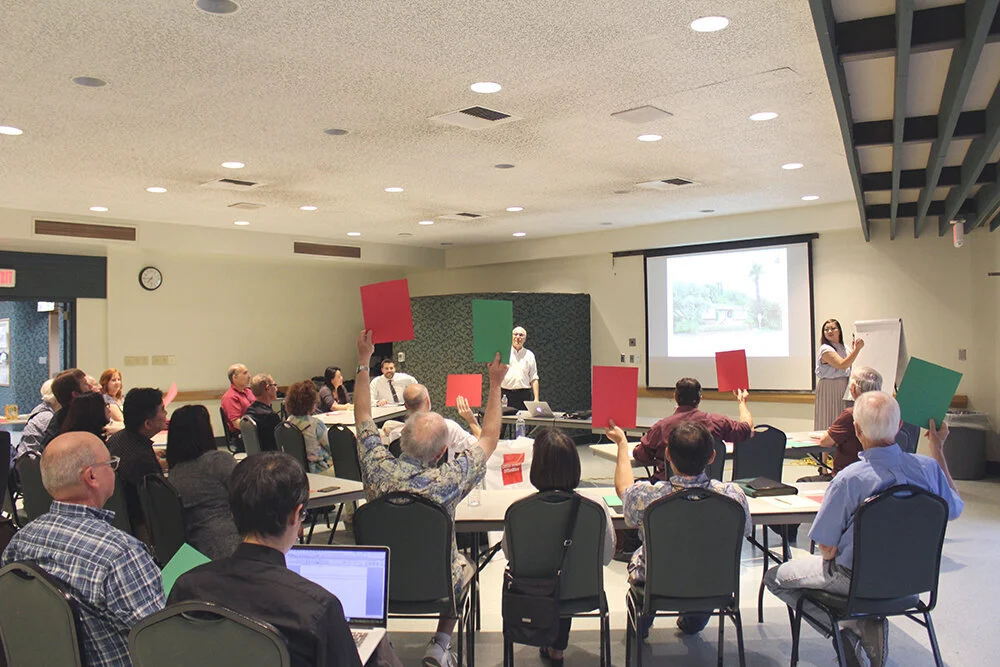
A sixty-minute survey exercise was conducted with the group as a whole. The survey exercise consisted of twenty site photographs of Park West. The group voted with red and green cards to indicate their “like” or “dislike” of  each photograph. A second ten-minute community comment exercise followed which gave participants the opportunity to share their interests/concerns and to describe what works and doesn’t work in their neighborhood. (Pg 151, PRA Request Response)

Here are images from the meetings:

Presentation by JKA, PRA Request Response pg 123

Presentation by JKA, PRA Request Response pg 123

Community meeting in Culver Crest, Culver City JKA blog

Community meeting in Culver Crest, Culver City JKA blog

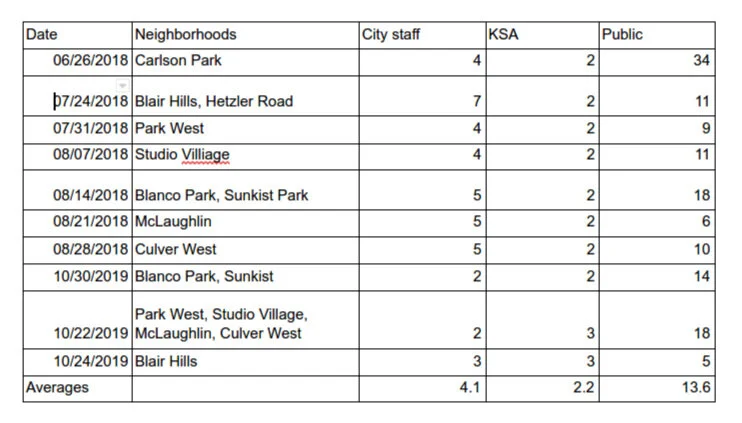
Below is a table summarizing the number of city staff at each meeting, the number of consultant staff and the number of participating members of the public:

table.jpg


The city staff and consultants are planners, most of them with advanced degrees. There is an average of 2 members of the public to each city consultant or staff member. The total number of attendees across the 10 meetings is 136, but the consultants reported 99 participants, which means 37 people came to 2 meetings, or a smaller number of people attended more than 2 meetings. Just in these in person meetings, a total of 94.5 professional staff hours were spent serving the emotional needs of 99 homeowners in Culver City. According to a scope of services memo submitted by KSA for a related project, their staff’s hourly rates are between $100 and $205. City staff time probably cost slightly less. 

According to a Professional Services Agreement with KSA executed in 2017, the consultant alone - not counting city staff time - cost up to $342,440. In addition to the 99 people who participated in person, another 239 residents answered an online survey. Culver City’s population is 39,437 which means every man, woman and child in Culver City paid at least $10 so that the local government could survey 338 residents to discover what kind of house they think looks cute, and what house looks ugly, and then craft new zoning reflecting those preferences. 

What an incredible level of service for those residents! What a solicitous local government. How lovely it is for this local government to carefully protect these residents from suffering from ugly houses. 

Culver City is our example city, but this practice is far from rare, in fact, every city runs programs like this for their low density, mostly white, single family residential neighborhoods. Culver City’s program, unfortunately, is extremely typical. 

 As we have seen in Culver City, even when residents expect houses to be single family and owner occupied, they believe that the “suffering” they feel due to homes merely looking like small apartment buildings entitles them to relief. How much more will their anxieties be when actual small apartment buildings begin to be built? If we are going to succeed in densifying low density neighborhoods, we cannot continue to treat these anxieties as a public problem.

Another reason to oppose the kinds of exercises described here, is that they are inequitably  provided. Anxieties about one’s changing neighborhood are universal, they are not more or less prevalent in any population. Nostalgia is something that all humans experience and share. However, we see that when white homeowners express these anxieties, planning departments rush to dry their tears, whereas when renters and non-white homeowners bring the same kinds of concerns to their local governments, the response is sluggish or absent. Local governments should treat all land use concerns equally - when there is a true life/ safety danger, they should respond quickly. When the issue is nostalgia, all populations should be on the same footing. 

Our budgets, as the saying goes, are our values. Why should Culver City spend at least $342,440 on a project that serves 338 residents who own their homes? Not only is it a very small number of people for the price, this population is not needy or in distress. There are about 1000 households under the poverty line in Culver City, what could $342,400 have done for them?

Zoning & Policing

Zoning is a police power. What does that mean? It means separate but related things. Mainly, the legal theory that allows the police to pull you over when you are speeding also legitimizes and justifies your local government’s ability to do everything from prohibiting apartment buildings in single family zones, to passing laws regulating specific aesthetic features of buildings. This is the same “police power” that undergirds all of our governments’ regulations that protect any aspect of public health and safety. Many of these police powers are good things, like ensuring toxic chemicals stay out of our food. 

In addition, political leaders, judges and other elites believe that using zoning to separate apartment housing and businesses in certain neighborhoods away from low density, single family housing is a policy that makes the job of the police force easier. In this sense, zoning as a police power is nested within the role of the police officer to promote “public safety” specifically by regulating who is allowed to be where. 

The connection between zoning and police powers begins over 100 years ago, in 1926 the Supreme Court of Louisiana, in State v. City of New Orleans, pp. 282-283, said:

... the exclusion of business establishments from residence districts might enable the municipal government to give better police protection. Patrolmen's beats are larger, and therefore fewer, in residence neighborhoods than in business neighborhoods. A place of business in a residence neighborhood furnishes an excuse for any criminal to go into the neighborhood where, otherwise, a stranger would be under the ban of suspicion. Besides, open shops invite loiterers and idlers to congregate, and the places of such congregations need police protection. (emphasis added)

One might think that apartment buildings are residences, because people live there, and therefore would be included as permitted uses in “residence districts” but one would be wrong.  Later that same year, the US Supreme court weighed in on whether cities had the power to pass zoning ordinances that prevented business uses in residential districts, and specified that apartments are not a residential use.

The serious question in the case arises over the provisions of the [zoning] ordinance [that] exclud[e] apartment houses, business houses, retail stores and shops, and other like establishments [from residential districts]. This question involves the validity of what is really the crux of the more recent zoning legislation, namely, the creation and maintenance of residential districts, from which business and trade of every sort, including hotels and apartment houses, are excluded. (emphasis added)  Village of Euclid v. Ambler Realty Co., 272 U.S. 365 (1926)

The court goes on to explain why apartment houses in particular are not only not residential uses, but are active nuisances to so called “residential” districts. 

With particular reference to apartment houses, it is pointed out that the development of detached house sections is greatly retarded by the coming of apartment houses, which has sometimes resulted in destroying the entire section for private house purposes; that, in such sections, very often the apartment house is a mere parasite, constructed in order to take advantage of the open spaces and attractive surroundings created by the residential character of the district. Moreover, the coming of one apartment house is followed by others, interfering by their height and bulk with the free circulation of air and monopolizing the rays of the sun which otherwise would fall upon the smaller homes, and bringing, as their necessary accompaniments, the disturbing noises incident to increased traffic and business, and the occupation, by means of moving and parked automobiles, of larger portions of the streets, thus detracting from their safety and depriving children of the privilege of quiet and open spaces for play, enjoyed by those in more favored localities -- until, finally, the residential character of the neighborhood and its desirability as a place of detached residences are utterly destroyed. Under these circumstances, apartment houses, which in a different environment would be not only entirely unobjectionable but highly desirable, come very near to being nuisances. Village of Euclid v. Ambler Realty Co., 272 U.S. 365 (1926)

Implicit in the State v. City of New Orleans opinion is the principle that effective law enforcement is equivalent to a generalized suspicion of strangers, and therefore the practice of law enforcement is the effort to keep different kinds of people separated from each other. In this case, the police power is concerned with keeping the kinds of people who live in apartments out of neighborhoods inhabited by the kinds of people who live in houses. It goes without saying that since apartments are cheaper than houses, what we are talking about here is virulent classism and racism. 

By 1926 the principle was firmly established that prohibiting businesses and apartment buildings in single family areas was reasonable and desirable because it facilitated the ability of police officers to ensure that higher income people would not come into unwanted contact with lower income people. Prohibiting apartments and stores in single family zones also removed any legitimate reason for a lower income person to walk around an expensive neighborhood, making the police officer’s job very easy. Any unfamiliar individual in a high income neighborhood could be assumed to be a criminal, because the legitimate reasons for their presence had been outlawed and eliminated. 

As the decades passed, the police power of zoning only expanded. The foregoing conversation explains the counterintuitive fact that apartment buildings are separated from single family zones, even though they are both residential uses, but it doesn’t explain why zoning is so intensely concerned with aesthetic issues. Even within single family neighborhoods, the police power allows cities to regulate to minute detail exactly what single family homes are permitted, and what aren’t.

In 1954 Berman v. Parker expanded the police powers to include aesthetics, in addition to “public health, safety and welfare”: 

The legal basis for all land use regulation is the police power of the city to protect the public health, safety, and welfare of its residents. ... The concept of the public welfare is broad and inclusive... The values it represents are spiritual as well as physical, aesthetic as well as monetary. It is within the power of the legislature to determine that the community should be beautiful as well as healthy, spacious as well as clean, well balanced as well as carefully patrolled.” (emphasis added)

In this quote Justice Douglas again ties land use regulation to the work of police. Just as police “carefully patrol” a neighborhood, so too can the legislature make land use regulations that ensure that a community is “well balanced.” What is meant here by “well balanced” is not clear. The term “Balance” in relation to communities was used in England in the 1950s as a synonym for “integrated”, it also sometimes meant “harmonious”. The fact that Justice Douglas puts “well balanced” in a pair with “carefully patrolled” implies that his notion of “well balanced” is related to the patrol. Whatever he had in mind as constituting a well balanced neighborhood, clearly, there is some element that, if present, would throw the community out of balance. He is reiterating the existing standard that regulating the demographic “balance” of communities via land use is a valid use of police power. 

Twenty years later, in Village of Belle Terre v. Boraas (1974) Justice Douglas continues on the same theme, “A quiet place where yards are wide, people few, and motor vehicles restricted are legitimate guidelines in a land use project addressed to family needs. . . The police power is not confined to elimination of filth, stench, and unhealthy places; it Is ample to lay out zones where family values, youth values, and the blessings of quiet seclusion and clean air make the area a sanctuary for people.”

What this means is that local governments have the authority to enforce vague concepts like “family values” and “youth values” and other “aesthetic” and “spiritual” values, and of course, when certain populations ask them to, they do.